urbanism – landscape – ideas – theory – whimsy

Beautiful Urban Moments – Part IV

Hop Scotch

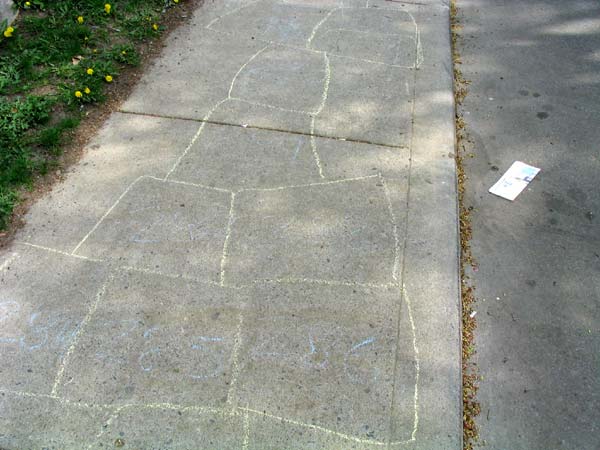
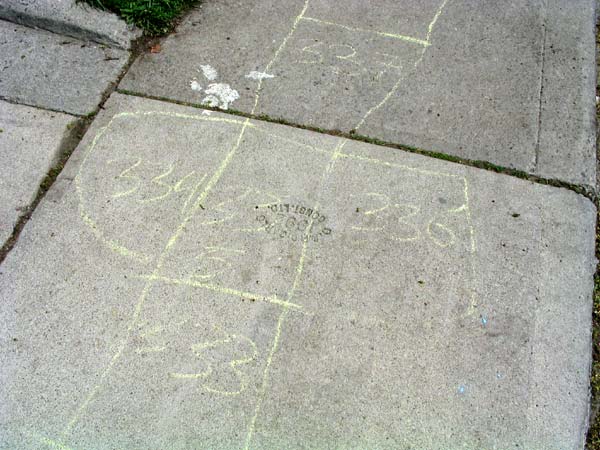
I stumbled across an energetically created hopscotch “board” on the sidewalk of Delaware Avenue north of College. The tireless kids got up past number 450 before petering out. I must say, that would be one hell of a workout to play! Unfortunately it rained briefly on Friday night and the “board” was gone by Saturday. Urban ephemera make for beautiful urban moments.

Hop Scotch2

Yup. They’re Too Big.

Too Big!

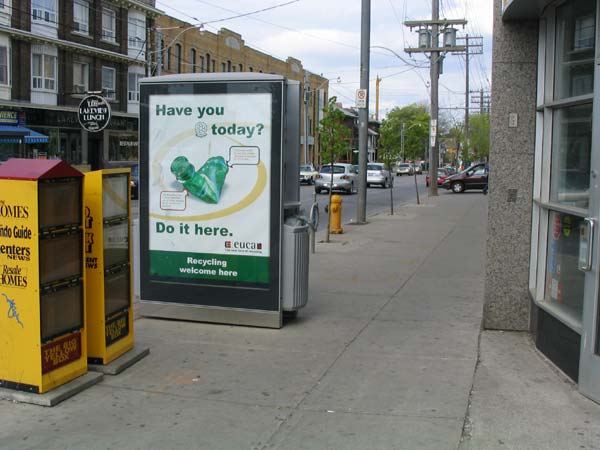
I know it’s old news. But it still boggles the mind. Toronto’s new waste and recycling receptacles are too big for the old inner city neighbourhoods. It’s rare enough to have a nice clear and wide sidewalk along many streets what with newspaper boxes, advertising sandwich boards, tree planters and all the rest of the streetscape paraphenalia. The last thing we need is a giant perpendicular garbage billboard taking up half of a sidewalk. Just look at the photo (taken at the corner of Ossington and Dundas) – it is actually taking up half the sidewalk!

And as for revenue, in the receptacle in this picture both sides have ads advocating recycling which I sincerely hope the City didn’t have to pay for – but of course, since this network of multi-tasking billboards are run for profit, you can bet those recycling ads won’t last for long.

I like to think that these abominations won’t either.

Edit: the spacing wire just answered my question (see here).

The Curious Incident of the Missing Bike Rings

IMG_7213_e.jpg

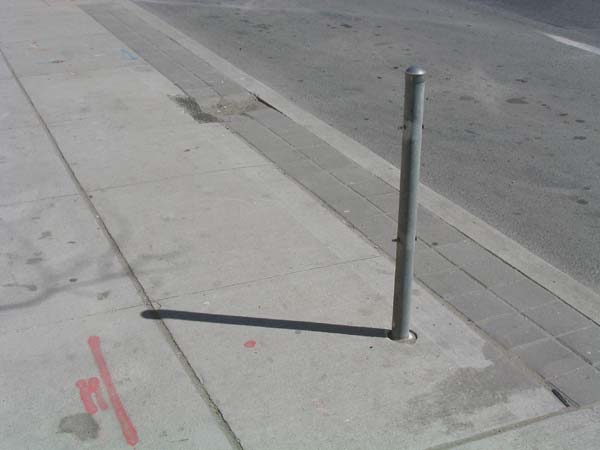
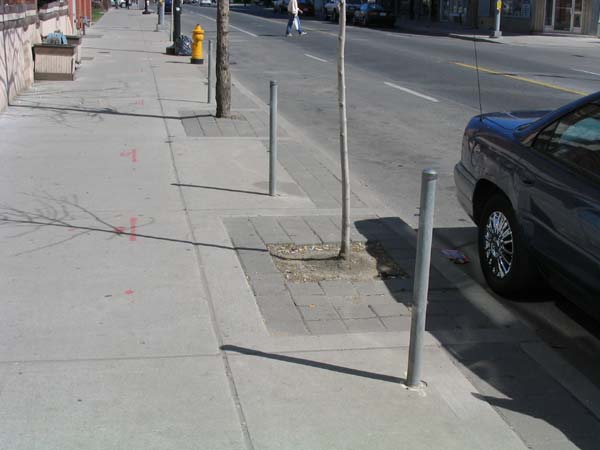
There’s a whole stretch of Dundas Street West, east of Keele Street, where all the Bicycle posts have lost their rings. It’s quite curious. Have they been stolen? Is it vandalism? Is there an official reason behind it? With summer fast approaching and fairweather cyclists snapping up all the available lock-up space, I don’t like to see unusable bike posts.

IMG_7212_e.jpg
IMG_7215_e.jpg

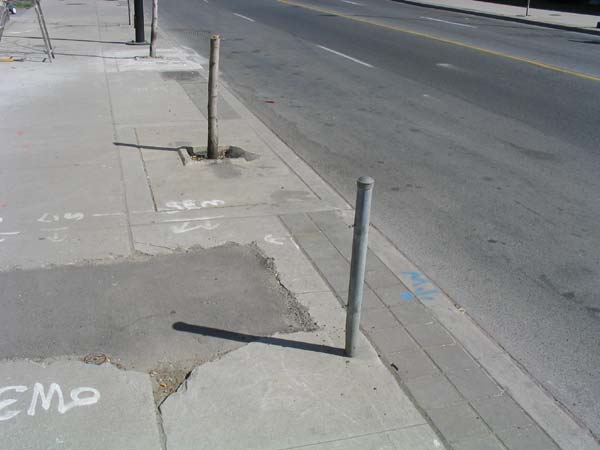
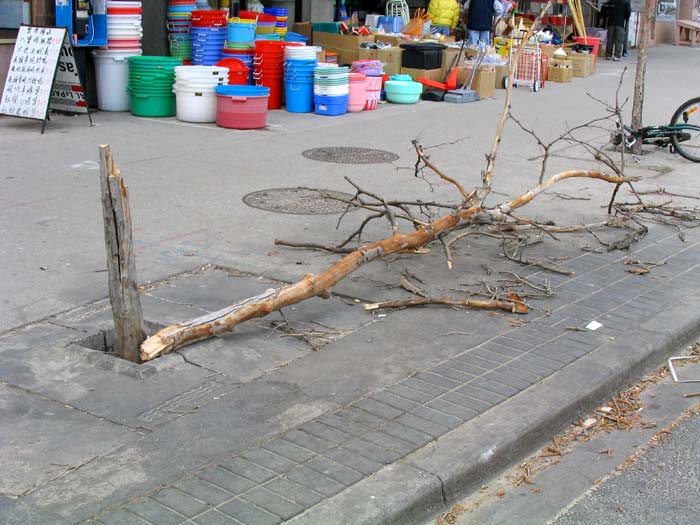
And here we have the ultimate combination – the ringless bike post next to the cut off stump of a poor little failed street tree. Toronto’s uplifting streetscape in the flesh!

FYI – there’s a cool new coffee shop with excellent fair trade organic coffee right around here – just across the street from McBride’s motorcycle shop (before you grimace, let me tell you it was $1.50 and was a great cup of coffee – organic milk and cream as well). As a matter of fact, the whole area’s hopping these days. Having grown up in the Junction, I’m pretty happy with the way things are going.

While you’re in the area check out Pandemonium, a great used book shop at Keele and Dundas – or if you can make it further west, the refined The Book Exchange stocks only very good condition used books – but don’t go by their website, it’s the pits.

Changes, changes….

I’m giving WordPress a try – it might take a bit for me to get things back in order around here.

And sorry if a link to a post has changed – they should all be here somewhere or other…. I’ve still left the original up at their locations for now, but they’re all duplicated in the new structure.

Please also note the Site Feed has changed – with WordPress it’s now RSS not Atom and the address (see sidebar) is https://www.bricoleurbanism.org/feed/ – I’m not actually sure it’s working properly, so if anyone’s having problems with it let me know via my contact form.

Hosting Switchover – Please Bear With Me


A sight seen far too often along the streets of Toronto. Spadina Avenue, March 2006.

I’m making a hosting switchover – please bear with me.

New Post Soon.

I promise!

A Question of Cycling Space

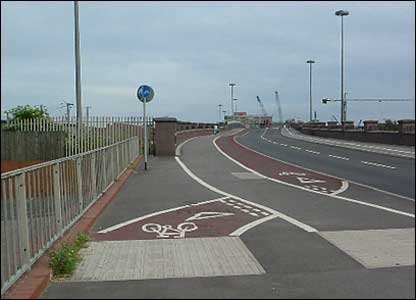
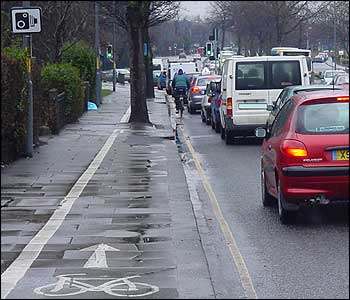
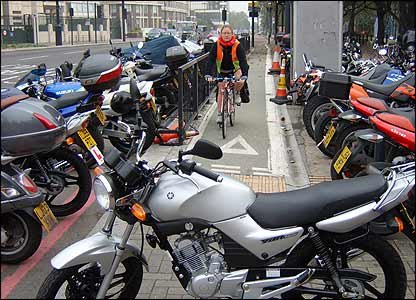
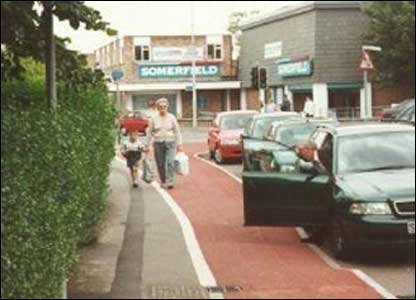
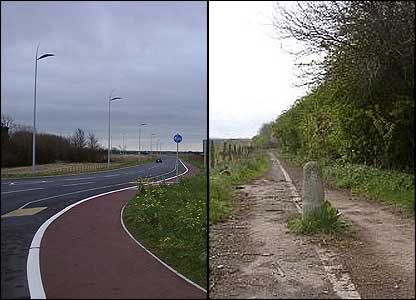
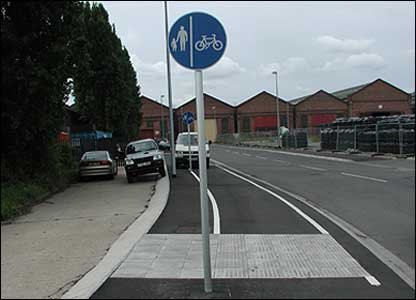
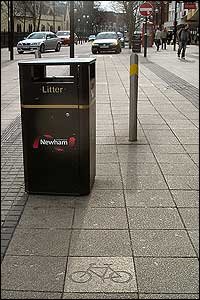
Cycling lanes and routes don’t always work out the way people hoped they would. And sometimes they’re just completely misguided. The BBC asked people to send in pictures of bizarre bike lanes (see here), and here’s some of the results (props to Tonto for the link).

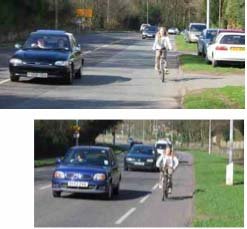
From the British Midlands, the Warrington Cycle Campaign (who have a great feature of bicycle lane cock-ups called Facility of the Month) has an interesting amateur report on “The Effect of Cycle Lanes on Cyclists’ Road Space” showing how a 1.5m wide cycle lane actually reduces the amount of road-space available to cyclists. Here’s some of the photo comparisons from that report.


Beautiful Urban Moments – Part III


This beautiful display of colour is outside of a laundromat on Ossington Avenue between Bloor and Dupont. As in so many cases, one person’s disposables are another person’s materials.

An Urban School Drop-off Debacle

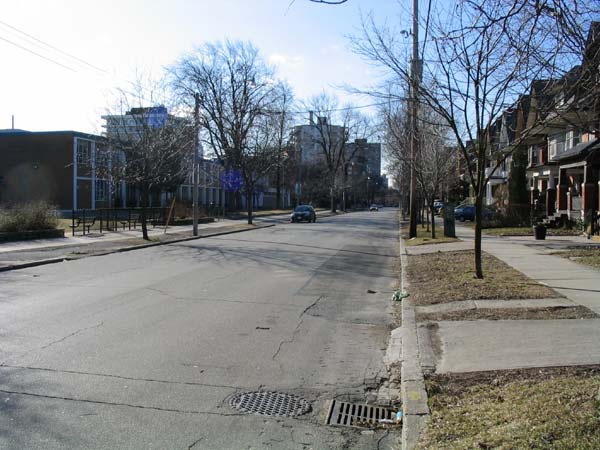
Huron Street Public School - 9am - march break

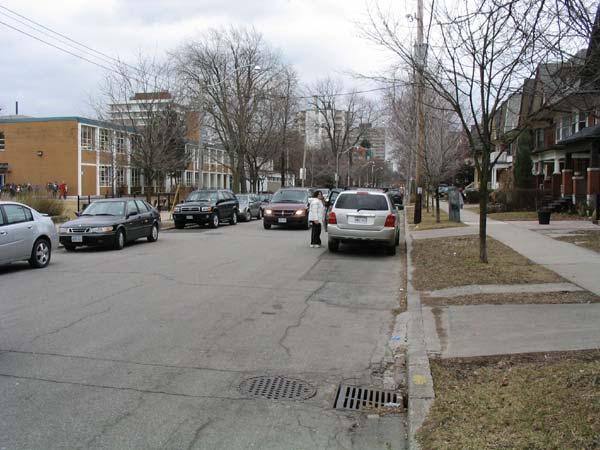
Huron Street Public School - 9am - week after march break

Huron Street Public School is a block and a half north of Bloor Street West, two short blocks east of Spadina Road, right in the Annex in downtown Toronto. It is within very easy walking distance of three subway stations – St. George, Spadina, and Dupont (roughly 250 m from the first two). It is also surrounded to the east by numerous 6-10 storey apartment buildings along St. George Street and of course sits within the famous, leafy, and relatively dense Annex neighbourhood, the same neighbourhood Jane Jacobs chose to live in when she moved to Toronto from Greenwich Village so long ago. She still lives just a few blocks away.

Given all of this, I am just dumbfounded at the number of people in this neighbourhood who seem to believe it necessary to drive their kids to school. The pictures above speak for themselves. There is no parking allowed on either side of Huron Street in front of the school. The teachers have their own car park around the side of the school. Every single car you see in the photos is there temporarily dropping someone off. It’s embarrassing, to put it mildly.

It’s also ridiculously dangerous. I cycle past the school every day – with cars stopped on both sides of the street, and two lanes of through traffic (mostly also parents) still moving between the stopped cars, it’s a cacophony of accidents waiting to happen as kids do their best to run from one side to the other amidst this mess. The worst insult is that the parking managment strategy of disallowing parking on this section of the street is a tacit approval for and enabler of parents to continue this negative behaviour.

The empty photo speaks volumes – the residential street is four lanes wide, a width that not only promotes parents in driving to drop their kids off (because there’s so much room to do so) but also seems to encourage speeding at off-peak times, while making it more difficult to cross the street. Is it not worrisome that even in the inner city, in Jane Jacobs’ own neighbourhood, we’re doing this bad of a job at promoting walking to school? How can we complain about suburban attitudes to driving, and especially school drop-offs, when this terrible example is sitting in our own backyard?

It looks like there’s a lot of work still to be done in changing even urbanites’ attitudes towards and use of the automobile. I can only hope that some enterprising activist public space organisation will get its ass out of Kensington one of these days and start “occupying” the drop-off space in front of Huron Street Public School and others like it. Now that I would like to see.

Of course, I’m also sure that building “a bicycle expressway along Bloor/Danforth” would solve this whole problem. Right? (that’s sarcasm in case you can’t tell)

Bicycle Lane Futures


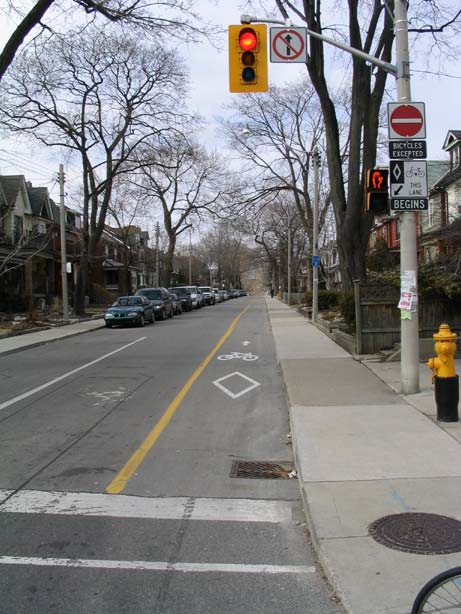
This is Harbord and Montrose in the west end of Toronto. It’s a marked bicycle lane going the opposite way on a one way street. It’s a fantastic solution to the plethora of one way streets that dominate the old inner city neighbourhoods of Toronto – streets that are organised in a deliberately directionally discontinuous manner to prevent traffic short-cutting through residential streets since most of the inner city was built on a relatively regular grid. Unfortunately, this organisation of one-way streets makes life difficult for bicycles trying to obey the traffic laws – so let’s face it, most of us frequently cheat and go the wrong way down one way streets. And of course we always stop at stop signs too, right?

Now call me a shit-disturber, but I can’t help think that instead of making “a bicycle expressway along Bloor/Danforth” (um, what did we build that subway line for?), we should improve the ability of cyclists to legally penetrate the city’s network of one way streets through schemes such as this one. There’s even a special traffic light at Bloor at the north end of Montrose with a bicycle-only green light.

Despite commuting to work every day by bicycle, I have to say I’m not a fan of normal bike lanes – these ones improving access to the city being an exception. The reason I feel this way is that bike lanes foster the impression that cars and bicycles can’t really share the roads – that bicycles in fact need their own lanes. Sure, that means they’re sharing the asphalt – but I worry that it means in the long run that drivers won’t be used to sharing their every day roads with cyclists. In european cities where bicyclists are supported with vast networks of bicycle lanes, this is almost my impression – that once you accept that bikes need their own space, you can’t stop – all of a sudden every new road needs a bike lane, every major road – in fact european bike lanes are frequently off the road entirely which is not exactly sharing the road, is it? It’s avoiding it.

The flip side to that concern is that bike lanes prevent cyclists themselves from acclimatising to sharing the road with other traffic – leading to a sense of confidence which, while theoretically desirable, is not based in the safety reality of urban cycling. Apart from the joys I find in weaving between traffic and demanding my own space on the road without an official line to decide the matter, it concerns me that too many bike lanes make it too easy for people who are not ready for city cycling to believe that it’s safe for them to cycle.

The first car you find “standing” in a bicycle lane, forcing you out into a traffic lane you’re not supposed to be in, might get you concerned. Then as you look back to talk to your friend who’s following you in your “safe” bike lane, someone in front gets out of their parked car without looking, stepping right into the lane and forcing you to either slam your brakes on, or again swing out into traffic to avoid them – that is if they didn’t hit you with their door in the first place. Further along, you come up behind a bus which, every time it comes to a bus stop, swings over into the bike lane, forcing you to either trail along behind it (breathing it’s lovely diesel fumes – a bus stopping at every stop moves along at just the right speed to keep in front of a cyclist – if you try to pass it, usually it passes you and cuts you off at the next stop) or swing back out into a traffic lane.

These are things that happen to me every time I use a bicycle lane. These are the realities of urban cycling. But in all of those cases, the bicycle lane is actually exasperating the problem – making the violation more of an affront than it otherwise would be because the cyclist believes that they have a “right” to that lane. While that may be the “right” thing, to me that kind of attitude leads to less safe cycling – rights don’t mean anything at the moment of contact between a 1 or 2 ton vehicle and a poor little cyclist. And you can always rely on other traffic to constantly violate the “safety” of bike lanes. Urban cycling is dangerous. Will more bike lanes along all of the busiest streets in the city make this better? I doubt it. Why are we encouraging cyclists to use the busiest streets in the city in the first place?

Instead let’s make it easier for cyclists to legally move through the quiet residential streets of the city – creating their own shortcuts to every destination imaginable. Bike lanes should be reserved for the most dangerous and problematic sections of road. And for those who don’t want to cycle without bike lanes? That’s what transit is for. Whether it’s about getting bike racks on buses and streetcars, or accepting that transit really is the better way, and despite using a bicycle pretty much every day (yes, all winter too), I increasingly feel that cycling as a means of transportation in the city (rather than as a form of recreation) is not, and will never be, for everyone.
Shaw & Yarmouth – a second shot

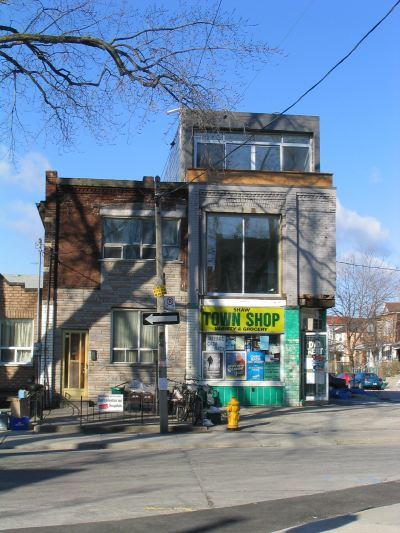
So here’s another photo of the little heightening project at Shaw & Yarmouth shown from the side in the last post (Development in Toronto Part IV – Heightening). I don’t know if it’s a much better photo, but you can more clearly see the extra storey in comparison to the left-hand part of the building.

For those familiar with Shaw Street, you’ll recognize this little gem just further south on the same block. Nothing like a little variety added to the nondescript streetscape!