urbanism – landscape – ideas – theory – whimsy

Self-seeded City

ailanthus - dundas st w

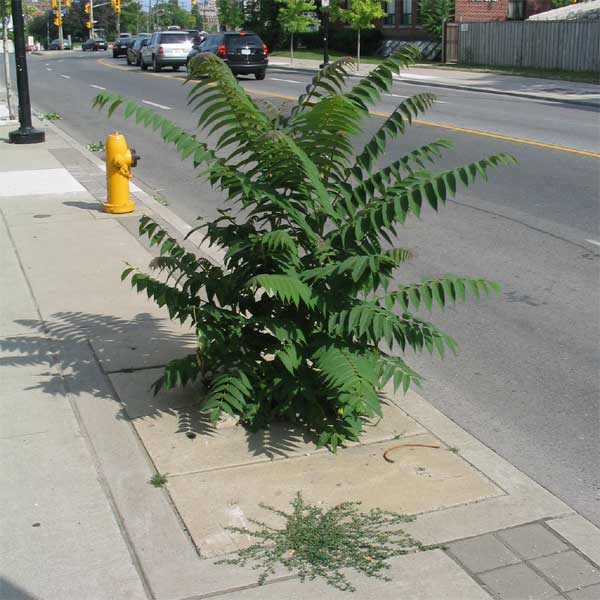
This is an Ailanthus (Heaven Tree, Tree-of-Heaven, Ailanthus altissima) seedling that has grown up in an unused tree pit along Dundas Street West in the Junction. In a city that has trouble getting healthy, nursery-grown trees to survive in the harsh conditions of the tree pit, there’s some irony to a tree naturally growing up in one from seed, and looking so happy to boot.

Unfortunately, there are few, if any, native species in Toronto, that can grow so happily in such conditions. The Ailanthus is, of course, not one of them, being native to China. It is also notoriously fast-growing, is naturalized in Toronto and much of the United States, is a prodigious seed-producer, and is very difficult to kill. In many places, it is also a voracious competitor against native species for light and resources, and due to its rate of growth and seed production, it usually wins. Combined with its production of a toxin that inhibits the development of other species, it is considered to be invasive and an ecological threat.

You will find the Ailanthus in laneways, abandoned and vacant sites, and along fencelines. There are few deliberately-planted examples in Toronto, one beautiful specimen on the University of Toronto’s downtown campus at Hart House Circle comes to mind. The tree in the 1943 novel (and film) A Tree Grows in Brooklyn by Betty Smith is an Ailanthus, allegorically referencing the species’ unstoppable ability to strive and survive even in the worst conditions. I once saw one growing out from behind a 2.5m wall that was only about 30cm from the building behind it.

I once harboured an idea that we could significantly green-up a city like Toronto (with difficult tree-growing conditions and little will to seriously tackle the street tree problem) by attempting to take advantage of some of the “weed” tree species by helping them to locate where we want them – imagine a beautiful, tree-lined laneway! Normally, we consider that there’s simply not enough room to grow trees there, but there are many examples of large Ailanthus, Elm (usually Ulmus glabra, or U. pumila), and Manitoba Maple (Acer negundo), vigorously growing along laneways.

The problem with this plan of course, is that all of these species are non-native, naturalized and invasive, and thus pose a particular threat to local natural vegetative communities in places like ravines and woodlots through their seed production. Whether it’s worth pursuing sterile cultivars or clones for the purposes of greening up the city is a bit questionable, and it would be almost delicious irony if the naturalized species itself seeded into the planting locations and out-competed our carefully selected non-seed producing (and genetically stagnant) tree.

However, since it doesn’t seem all that likely that we’ll ever get rid of these “unwanted” opportunists, maybe just leaving a cutout every 10 metres or so in the concrete of laneways would be enough of an invitation? After all, if you can’t beat ’em, use ’em.
Paradise By Any Other Name…

Paradise By Any Other Name...

What’s in a name? that which we call a rose
By any other name would smell as sweet;
(Romeo & Juliet, Act II, Scene 2)

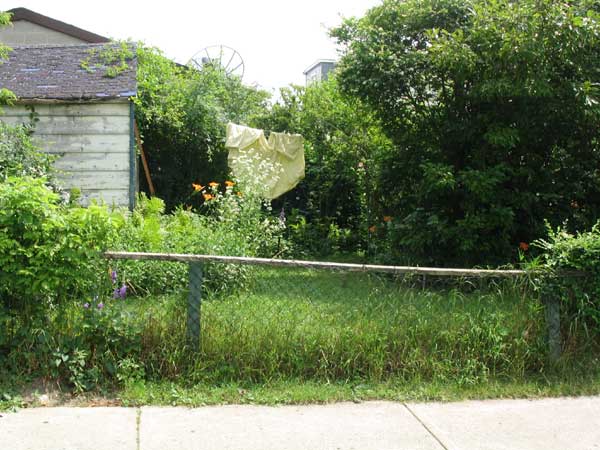
Every once in a while I come across a litte garden in the city that, perhaps unconsciously and for the briefest of moments, becomes worthy of an urban idyll, a little piece of paradise that reinvigorates my faith in the city.

Perhaps it’s the single sheet hung out to dry, or the ramshackle shed and overgrown fence, or the little patch of grass tracing the outlines of a path, or the unkempt and slightly wild “cottage garden” mystique.

Whatever it may be, it reminds me of the importance that private outdoor space plays in the city, even to those who can’t use it. Call it a vestige of the picturesque, but I feel that there remains a great value to the view into space (especially if it be green) even when we can’t access it ourselves – indeed I have noticed that the experience of being in a space that has looked so inviting and refreshing from afar frequently disappoints.

Anyone who has been to Venice will know of the intrigue and lusciousness that gardens hidden behind walls and glimpsed through gates and arches can bring to a city – so the next time you’re walking around your neighbourhood, stop and appreciate a moment of paradise, however brief, and then move on, and never regret that you have lost something by leaving, but rather stay vigilant, and await with utmost anticipation your next spatially-vicarious paradisical revelation.

Drakespawn

westsidelofts-queenw

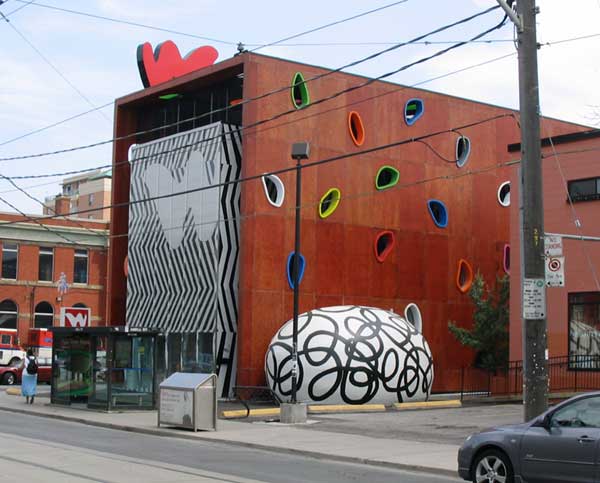
The influence of the Drake Hotel continues. Whichever side of the issue you fall on, you can’t argue with the results – changes along Queen West between Ossington and Dufferin have been both pronounced and rapid, from cafes and bars to boutiques and Starbucks.

Those changes are just the tip of the iceberg – a couple of significant condominium development proposals are currently in negotiation south of the Drake in the area dubbed the West Queen West Triangle – and this bizarre sales centre for the “West Side Lofts” (stuck right beside Woolfitts) is the harbringer of things to come.

While it’s exciting that they’ve broken with the staid and obviously temporary standard typology of the sales centre, the flip side is that the aestheticisation of architecture and design in this case is entirely for the sake of attracting attention in the form of sales – once that function has been fulfilled, the building will disappear. This seems a more and more common “programme” of contemporary architecture (read ROM, AGO), one which almost of necessity neglects the other responsibilities of buildings towards the urban fabric.

I suspect that the debate over the influence of the Drake and the nature of gentrification along Queen West is just getting started.

Development in Toronto Part V – Simulacra

lowther-old

lowther-new

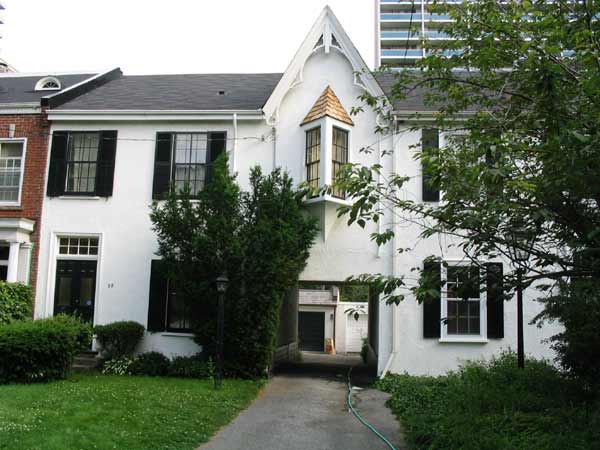
I could have used any number of examples in Toronto of simulacric development but this one in particular caught my eye since construction has been in process for months and months and I go past it almost every day. These two buildings are on Lowther Avenue just east of Avenue Road. The top photo is the original – an interesting semi-detached building form with covered access to the rear garages which I suppose must originally have been for coaches to access the coach houses. This form still has a few survivals – all of the ones I know are very near to this one in Yorkville, and you can almost imagine them being built at a time when Yorkville was a village a short distance north of Toronto, surrounded primarily by agricultural land and large estates.

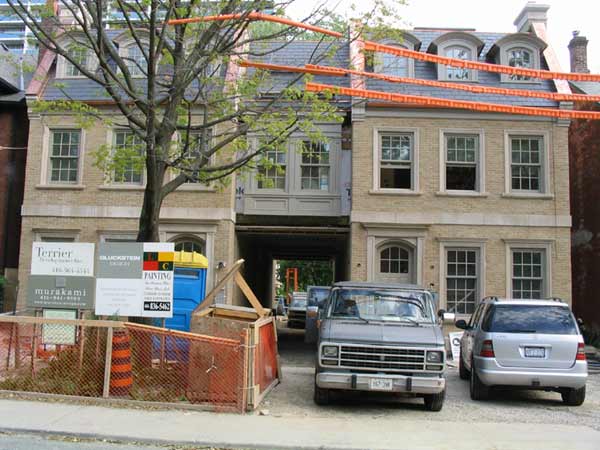
The simulacrum is just down the street. It too appears to be two semi-detached units with a covered passage to the rear, but has an additional third storey. I can only think that the City must have given permission on condition that the building fit in, but it’s certainly rare to see an old form so religiously copied. One wonders whether the real genesis of the idea came from the developer, the architect, or the City! Unfortunately, construction’s been going on so long that I can’t remember what occupied the site before, so for all I know they tore down an unprotected historical building in order to build this.

I’m of two minds about this building actually. One side of me really appreciates the lengths they’ve gone to to reproduce an historical form that is none too common in the city and which (by virtue of “hiding” the garages round back) achieves some contemporary urban design objectives. The other side of me wonders how much money they must be selling them for given the location and the fact that they’re pretty much replacing two units where there may have been two before. Which also brings up the perpetual mysteries of real estate development economics – how can this be profitable given land values in the area? Why are small-scale apartments (even if they are condominium) seemingly so hard to develop in Toronto even where land prices are high? Lastly, I wonder if the area or street has some kind of zoning protection which effectively stops anything denser than this kind of development. But I’m too lazy to actually bother finding out, so I’ll leave it at that. If anyone knows any more about it, drop me a line.

I haven’t even touched on the real simulacric question here – does the simple reproduction of a form like this, with dressed up styrofoam detailing and faux stone wall construction really act as a stand-in for the original? Is there something missing in this kind of reproduction? The value of the historic example is to me self-evident – but given current construction techniques, will the new simulacrum ever build that kind of value over time? Or will it simply one day be replaced after all the stone and styrofoam falls off and it’s horribly out of style? I wonder.

Take Cab – Watch for Bike

cab window

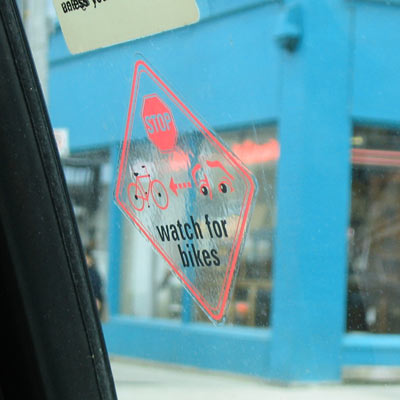
Not that I take cabs very often, but I happened to be in one today and noticed these cute little stickers on the inside of the rear door windows. Getting doored by passengers getting out of cabs is a drag – especially since it can easily happen on both sides of the taxi because cabs so often discharge passengers quite a ways off the curb. So the next time you take a cab, remember to watch for a bike when you’re getting in and out.

But why are you reading this? You should be watching the World Cup.

Honestly!

Toronto’s Future Waterfront a la West 8 / DTAH

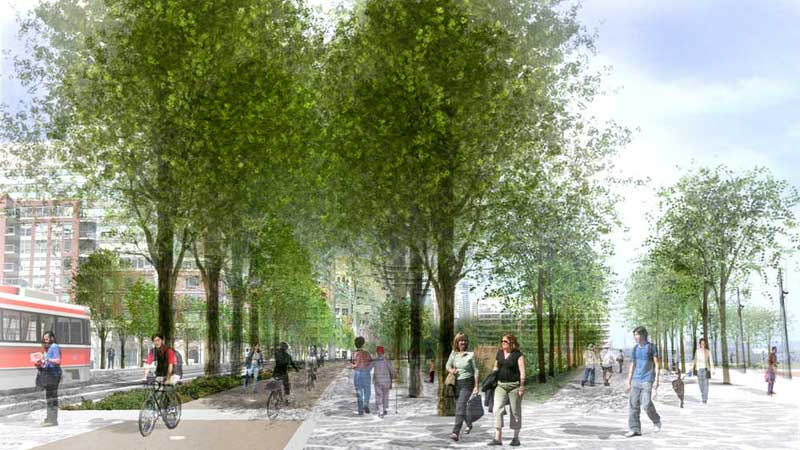
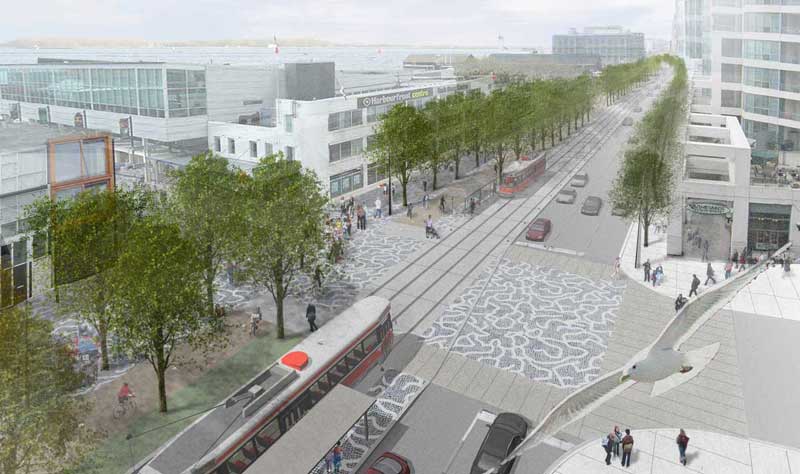
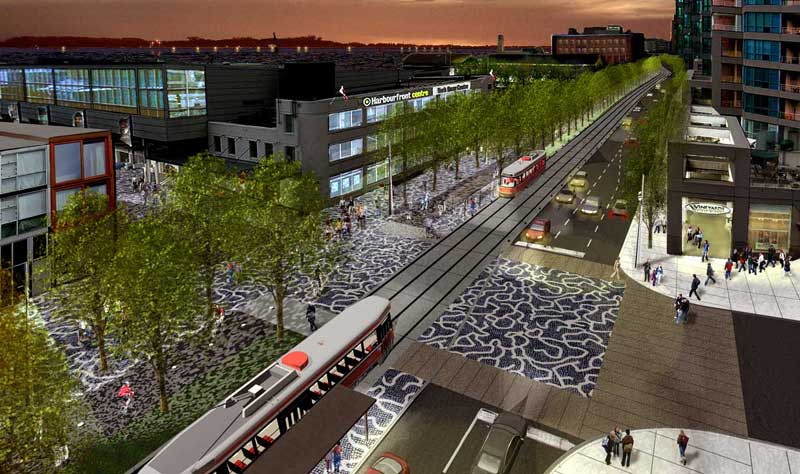
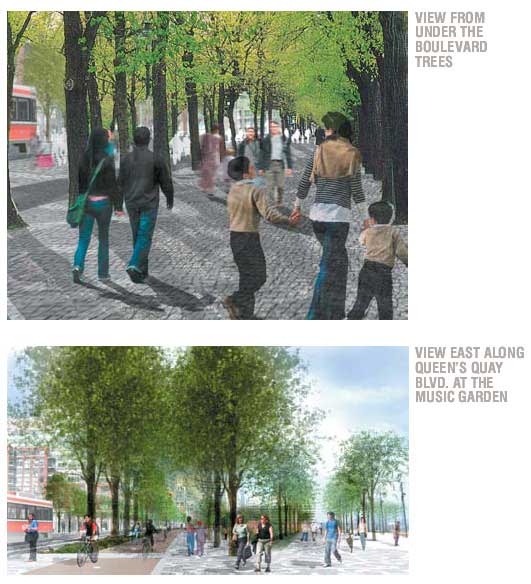
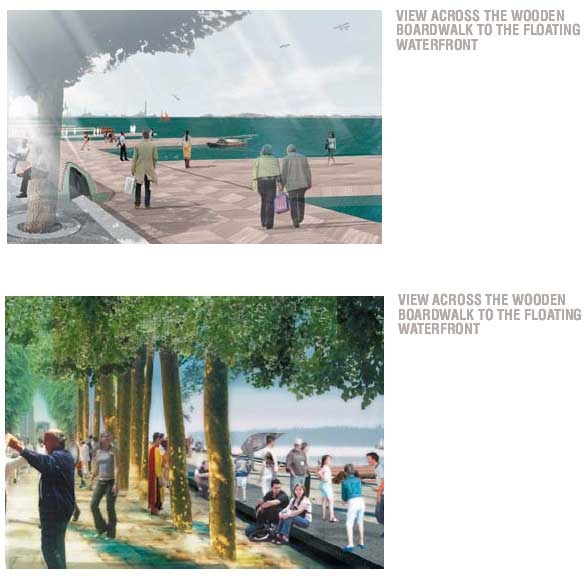
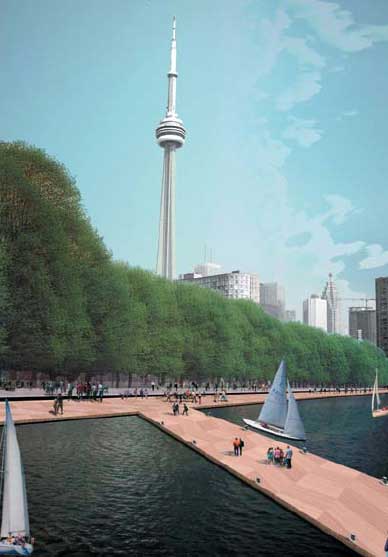
Some evocative renderings by Toronto Landscape Architecture and Urban Design firm du Toit Allsopp Hillier from the winning proposal in Toronto’s Waterfront Innovative Design Competition. Congratulations to the West 8 / DTAH team.

I reported on the result (with more images from the scheme) and set myself a-musing on its possibilities in a post yesterday. Click images to enlarge! Enjoy.

Waterfront Promenade - The Green Foot

Queen's Quay - Day View

Queen's Quay - Night View

Vancouver’s Progressive Cyclism

vancouver-a

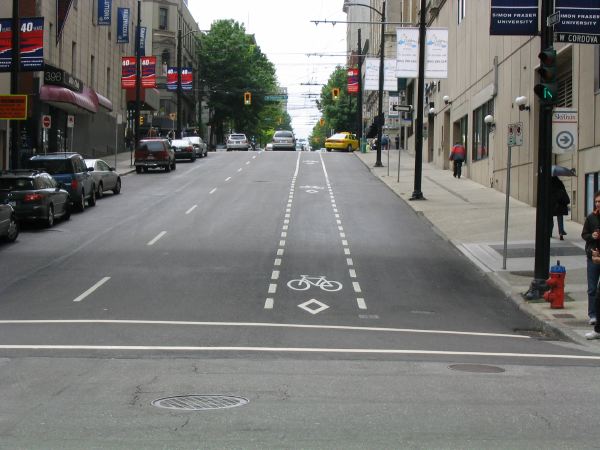
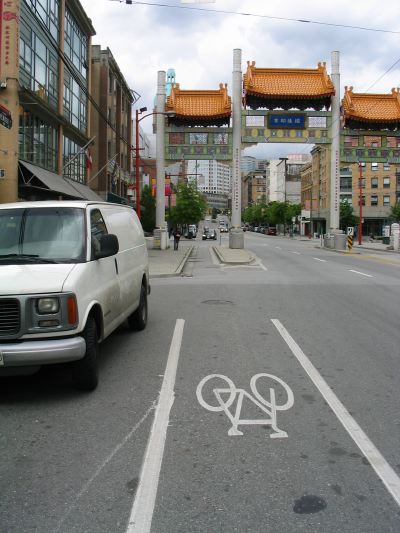
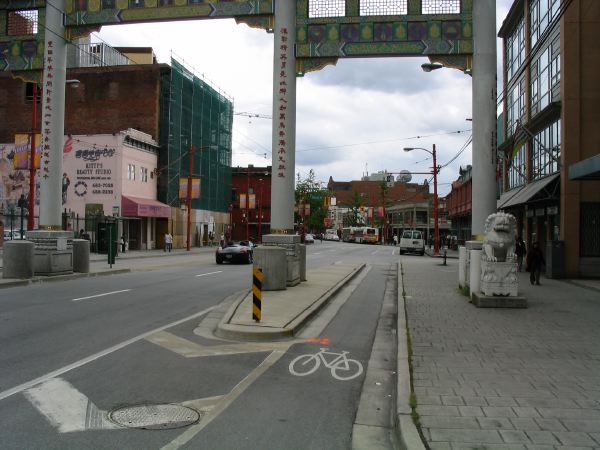
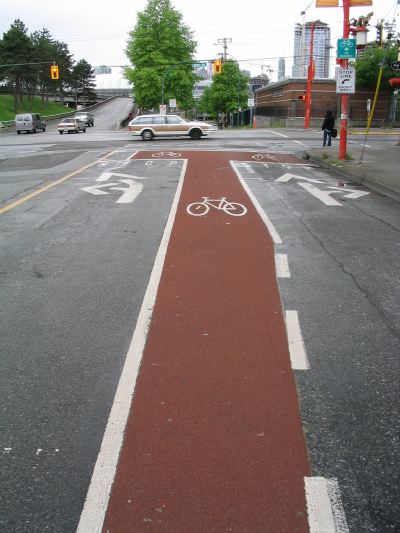
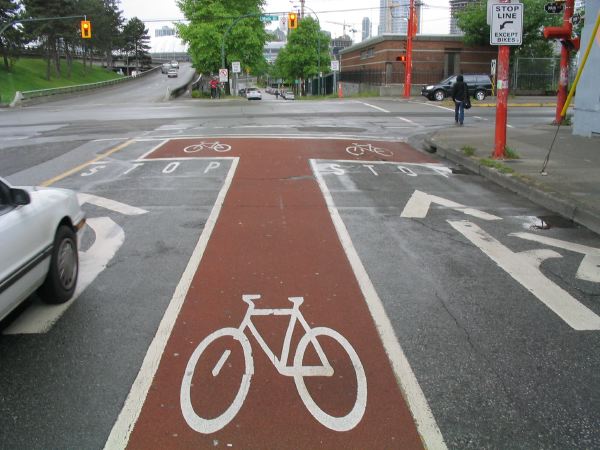
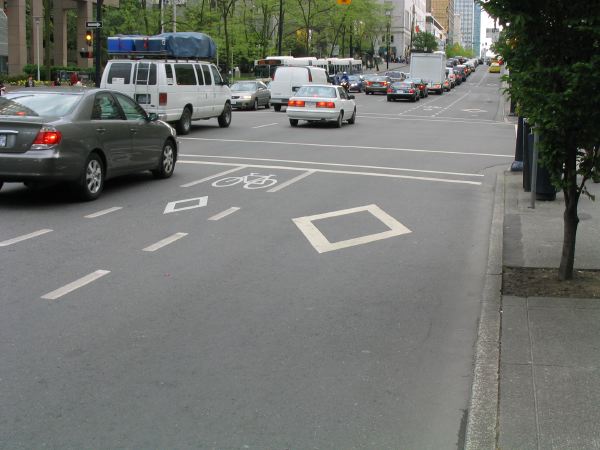
I was recently in Vancouver and noticed several fine examples of interesting approaches to bicycle lanes. I think it’s high time Toronto started experimenting a little more with alternate approaches. The only caveat to that being that many of Vancouver’s main streets are quite wide, and downtown are often one-way, so they tend to have more room to play with.

My favourites were the red/umber asphalt surfaced bicycle lane (similar to the colour used on British cycle and bus-only lanes), and the location of a separate “diamond” bicycle lane on the non-curb side of the bus/taxi “diamond” lane – an innovation any cyclist using the Bay Street “diamond” lane would appreciate, after all why should cyclists have to share their lane with some of the largest vehicles on the road (that constantly stop) and the craziest drivers (who also frequently stop)?

vancouver-b

vancouver-c

vancouver-d

vancouver-e

vancouver-f

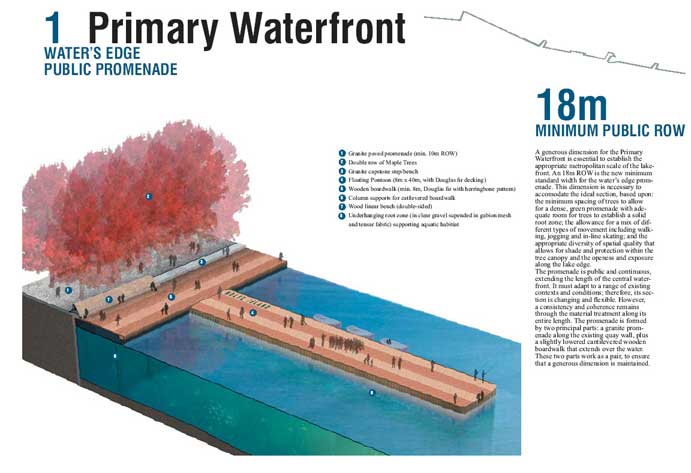
West 8 / DTAH win Waterfront Design Competition

primary-waterfront.jpg

TWRC and the City today announced that the West 8 / Du Toit Allsopp Hillier team were the winners of the waterfront design competition. See TWRC and DTAH websites for details and many more images.

I think we all know the best proposal won. Let’s hope that the scheme goes through with the same principles (maybe sans giant floating maple leaf).

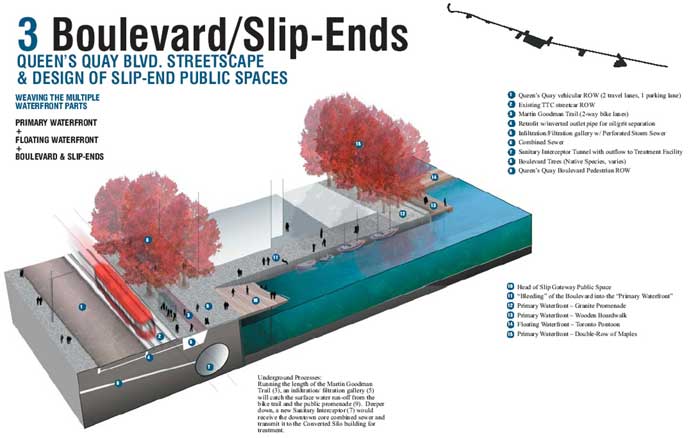
boulevard-slipends.jpg

ADDENDUM:

The winning scheme proposes the demolition of the Gardiner Expressway, to be replaced with a Champs Élysées-style boulevard, but it’s attitude towards the railway corridor (the real barrier to the waterfront) is more ambiguous. Knowing Toronto’s politics and methodology, the danger of insisting upon pinning the scheme to the demolition of the Gardiner is delaying design development or construction until agreement can be reached on the Gardiner (and that might be akin to waiting for Hell to freeze over).

Alternatively, going ahead with the Queen’s Quay, slip, and waterfront promenade work without a commitment to demolishing the Gardiner would fulfill the mandate of the competition’s terms of reference, while giving little leverage to force action on the Gardiner question. This whole issue is aggravated by the fact that the existing development along the north side of Queen’s Quay deliberately turns its back on the Gardiner (for obvious reasons), and consequently Queen’s Quay operates quite independent of the Gardiner/Lakeshore Boulevard co-dependency. It is therefore hard to practically argue that a Gardiner demolition is essential to the work on Queen’s Quay.

We’ve seen this play before – some of us might remember the euphoria that accompanied the Fung report and the release of the Making Waves Part II Plan for the Waterfront, both of which gave the impression that the Gardiner would soon be a piece of history, until the Front Street extension became TWRC’s first priority – a project that now seems to be on hold, but which is a constant threat hanging over the Gardiner’s future.

Adrian Geuze of West 8 might be blissfully unaware of the machinations of the Toronto undercurrents, but that doesn’t mean that the proposal to demolish the Gardiner is wrong. The idea of a Champs Élysées-style boulevard is in fact a huge leap forward since most other schemes have proposed a tunnel (akin to Boston’s hugely expensive Big Dig) which is tantamount to accepting the failure of the whole idea in advance.

I think the issue of the Gardiner is so divisive that I wouldn’t be surprised if it became a mayoral election issue in much the way the fixed-link to the Toronto Island Airport became the issue that galvanised David Miller’s win in the last race. There are enough drivers who adore the views and experience of driving the Gardiner (regardless of the cost to the city and the waterfront) and functional transportation thinkers who have a hard time imagining how the boulevard could make up the capacity of the Gardiner, that I would be worried to rely on a plebiscite to settle the issue.

There is the additional oddity that along the western waterfront there are three directly parallel and adjacent large roadways all making their way towards downtown – Lakeshore Boulevard (6 lanes?), the Gardiner (not raised, 6 lanes?), and the Queensway (6 lanes?). My question is, if the raised downtown section of the Gardiner was demolished and replaced with a boulevard (presumably eliminating Lakeshore Boulevard which practically runs beneath it), would that then enable removal of one or two of these western arteries which pose such an enormous barrier between the western waterfront and the city?

If the Gardiner did ever come down, I can’t think of a better reason to dramatically improve the GO train service along the waterfront corridor. Improved service and frequency in both directions throughout the day could go a long way to relieving possible congestion or increased travel times resulting from a demolition of the Gardiner. A perusal of current schedules shows that frequencies aren’t too bad – except who wants to wait an hour for a train? Running a better service might require electrification of the lines (which allows quicker stopping and acceleration after a stop and therefore increased number of stops) possibly allowing for the running of local and express lines with better travel times than the Long Branch streetcar line. An integrated GO transit – TTC fare structure / transfer privileges wouldn’t hurt either. Hey, if we can dream about demolishing the Gardiner, surely we can dream about improved transit?

queensquay-perps.jpg

waters-edge-view.jpg

view.jpg

Beautiful Urban Moments – Part V

Dovercourt Park - Spring

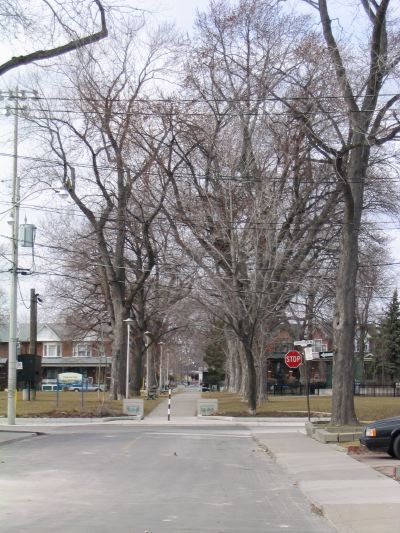
One of my favourite Toronto park moments is the allée of silver maples that cuts north-south through Dovercourt Park in the west end. The park is half-way between Dufferin Street and Dovercourt Road, and half-way beween Bloor Street West and Dupont Street. If coming along Shanly Street one block south, you look north up Salem Avenue and are treated to the allée continuing the line of the street through the park.

Apart from the lack of strong formal elements in most Toronto Parks (especially allées), this park is additionally special in that it is a park along the lines of the real English “square”. It is surrounded by small residential streets on all sides, and it is larger than most of the other Toronto “squares”. It successfully works as a whole where so many others dissolve into a collection of uncomfortable uses. The allée also brilliantly divides the park into an open field on the west side (laid out for baseball – I think unfortunately), and a series of more discreet uses on the east side, including a kids playground, a community centre, and tennis courts. If there was a wrought-iron fence around it and the baseball field was just an open field, it could almost be an English “square”.

Unfortunately, the silver maples are (as are so many of Toronto’s majestic Acer saccharinum) reaching the end of their life span. There are gaps in the allée already, and the City has started replanting the missing trees (though bizarrely, by my eye, they are not placing them along the line of the centres of the existing trees, but along their forward edge – very disappointing).

Sometimes simple spaces work best. Many of our new parks, such as the Central Park in the West Railway Lands (Concord Adex Park), or Wychwood Carbarns Park, will be so crammed full of programme, there’s no room for simple space and a grand idea. I can’t help think that we’ve lost something along the way with our busy-body urbanism.

Dovercourt Park - Winter

Ringless Bike Posts – Update

Bike Posts Re-Ringed!

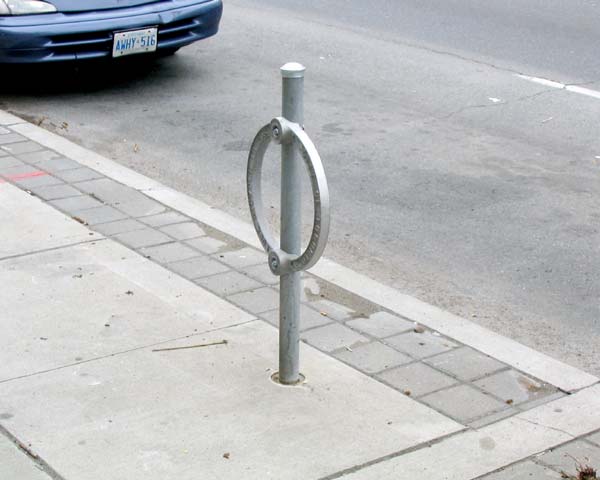
I am pleased to report that the ringless bike posts along Dundas Street West east of Keele that I described last week have been re-ringed (well, a lonely two are still ringless, but it’s an improvement). It’s good to know that the City’s services are capable of working this fast when they’ve been made aware.

All credit should go to Matt Blackett over at the spacing wire who saw fit to give the orignial incident widespread exposure (see here) and then Dylan Reid who followed up with contact information to get the problem fixed (see here).

Bike Posts Re-Ringed!

By the way, the cafe opposite McBride’s Motorbike shop I mentioned in the original post is called “Cool Hand of the Girl”. Give it a try. The Agora cafe a few blocks west of Keele is also a good bet.