urbanism - landscape - ideas - theory - whimsy

Sub-Prime Crisis in Cleveland

cleveland_2.gif

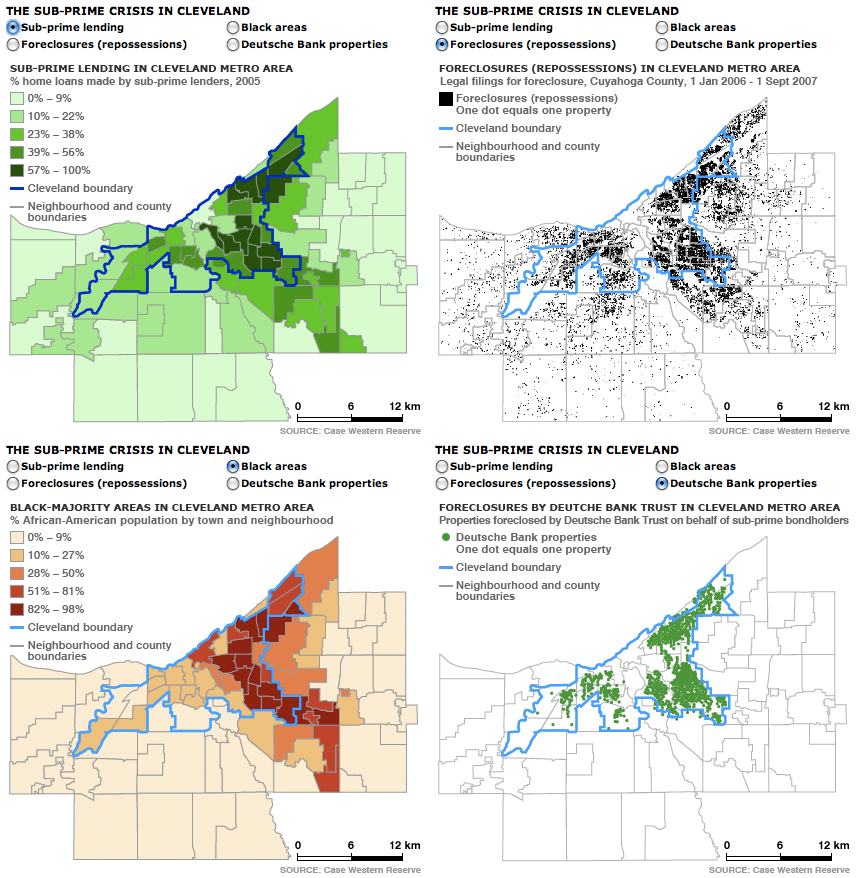
BBC News presented this set of maps in an article on the sub-prime crisis in the US (The US sub-prime crisis in graphics). Cleveland has been particularly hard hit by housing foreclosures, as the maps show, but when “one in ten homes in Cleveland had been repossessed” (as of late 2007) and “Deutsche Bank Trust, acting on behalf of bondholders, was the largest property owner in the city”, you begin to grasp the true horrible scale of the problem and are left wondering if this is the tip of the iceberg.

Mapping Our Urbanism Part VI - Income

toronto-3cities_2.gif

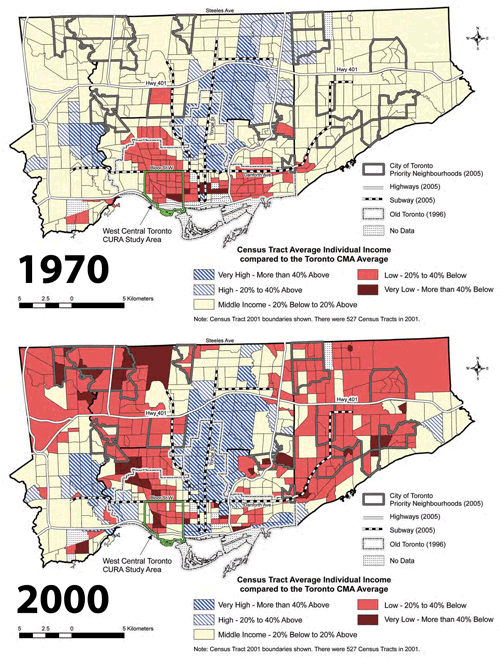
This animated map showcases the datum bookends of the excellent publication The Three Cities within Toronto: Income polarization among Toronto’s neighbourhoods, 1970–2000 by David Hulchanski from UofT’s Centre for Urban and Community Studies (downloadable from their website). Income levels are shown as census tract averages as relative to the average for the Toronto CMA - the light pink is middle income (20% below to 20% above average), with the most interesting change occurring between that and the darker pink representing low income areas (20% to 40% below average).

The geographic explosion of lower incomes into the inner suburbs of north Etobicoke and Scarborough is almost stunning, but I think reflects a lot of our current received wisdom about the changes taking place in Toronto, in particular gentrification in old inner city neighbourhoods and the consolidation and bulwarking of high income areas. In short, it speaks volumes about housing affordability in the currently valued neighbourhoods of the city, and indicates that those who can afford to are abandoning many of the inner suburbs.

toronto-3cities_orig-sm-e.jpg

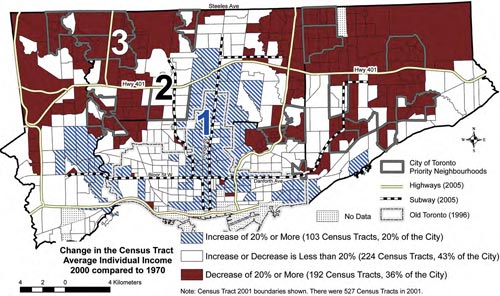
The more famous map from “The Three Cities” report is this one (above), which highlights those areas with the biggest increases (blue hatch) and decreases (dark brown) in average income between 1970 and 2000 - in this case, white areas are considered relatively stable. As you can see, looking at it this way clearly shows both gentrification at work and that the census tracts with the largest decreases in average income are almost all in the inner suburbs.

Hulchanski calls this a dramatic polarization and segregation of the city based on income, and firmly makes the point that we are capable of addressing this trend through better policies on housing affordability and requiring more affordable units in new developments to ensure that mixed income neighbourhoods are the norm instead of the exception: in his words “The segregation of the city by socio-economic status need not continue. It can be slowed and reversed.”

Crossposted to spacing toronto as part VI of a series - to view the five earlier parts follow these links:

Mapping our urbanism Part V - watersheds

Mapping our urbanism part IV - language

Mapping our urbanism part III - water mains

Mapping our urbanism part II - extents

Mapping our urbanism part I - snow ploughing

Urban Fabric & Form Comparison

urban form comparison

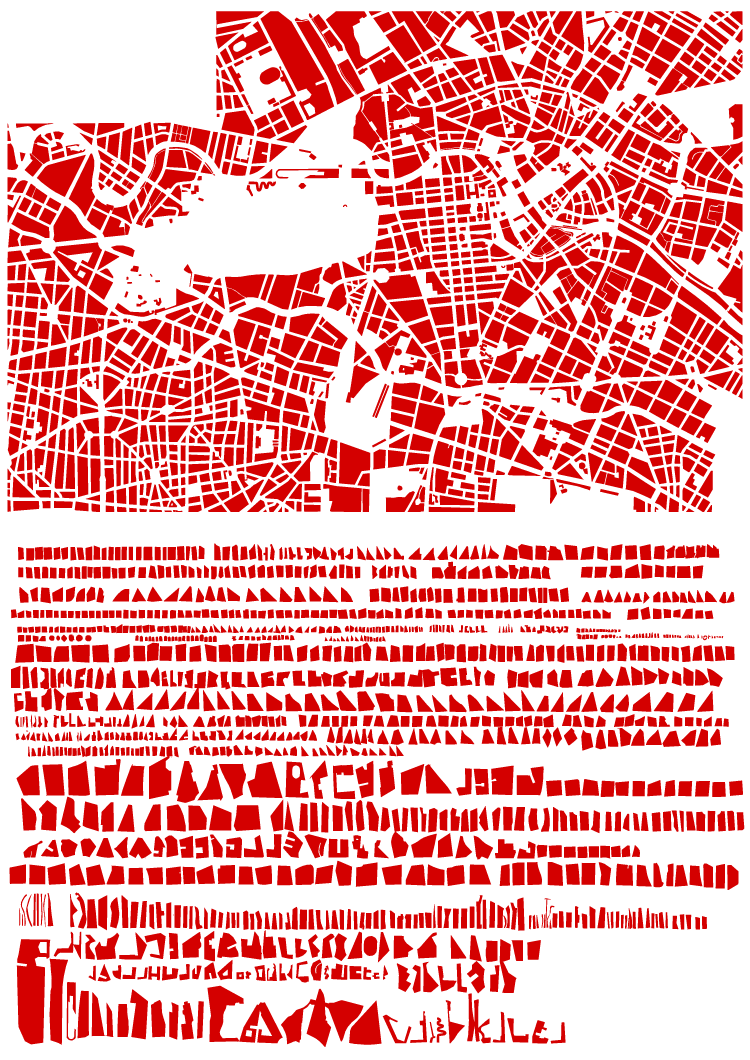
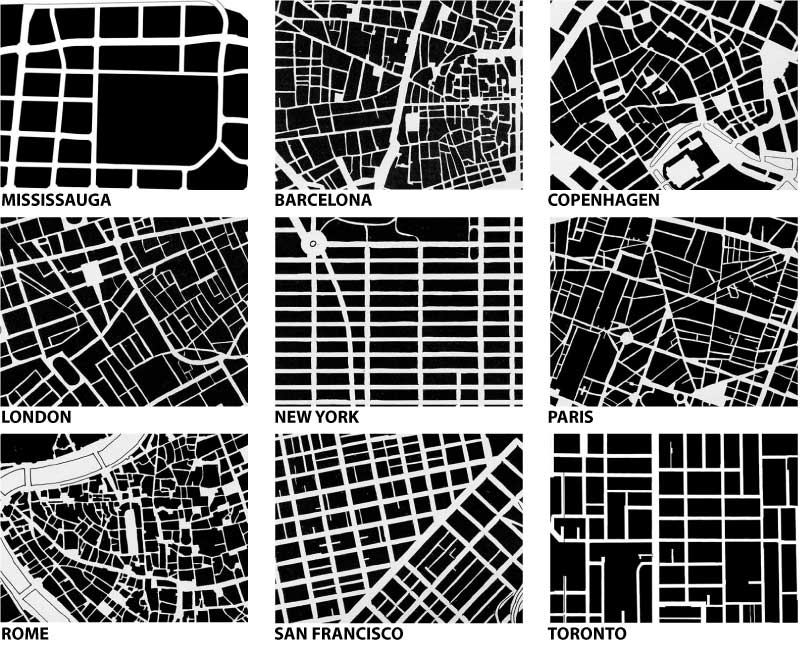
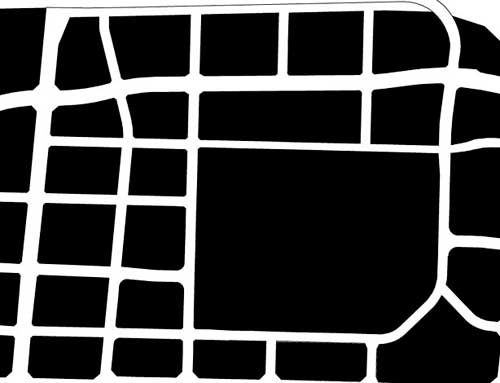
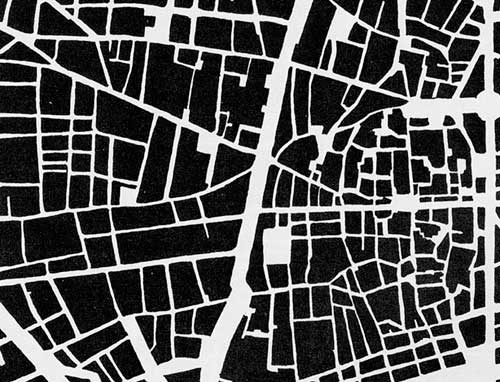
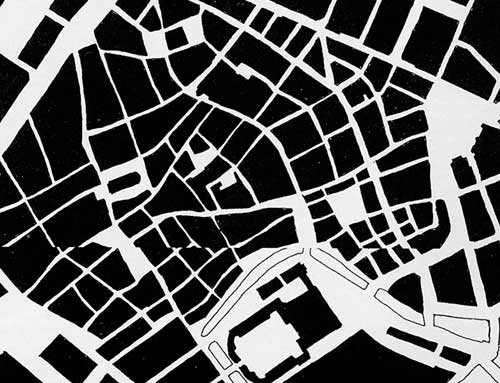
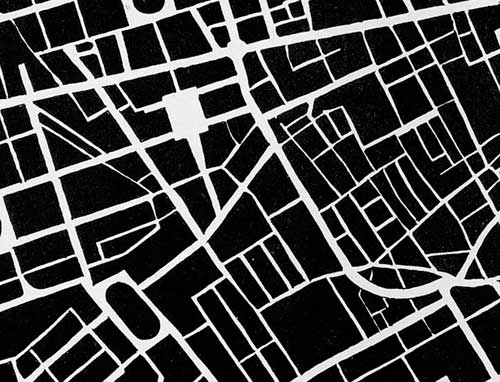
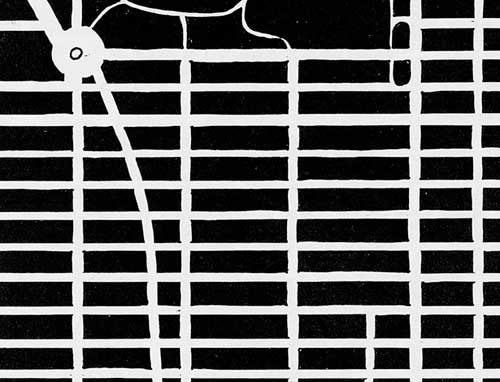
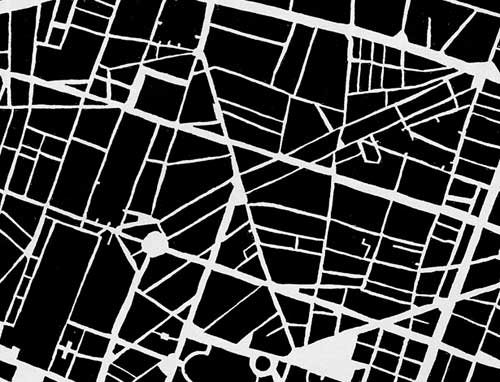
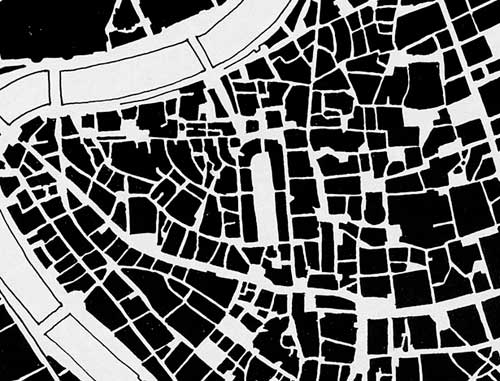
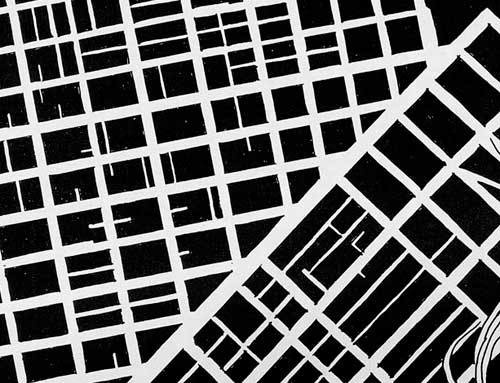
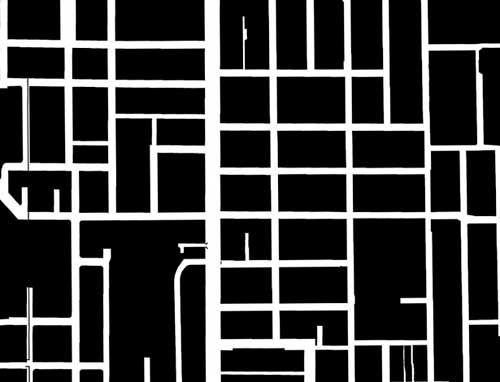
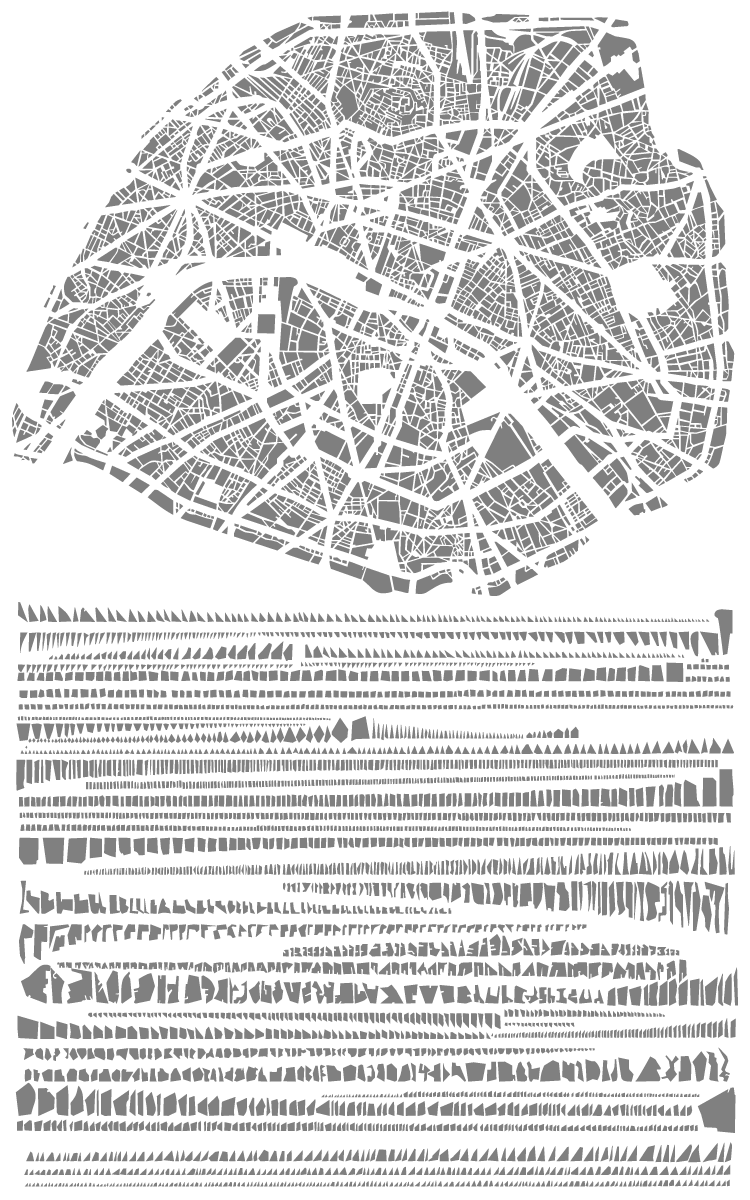
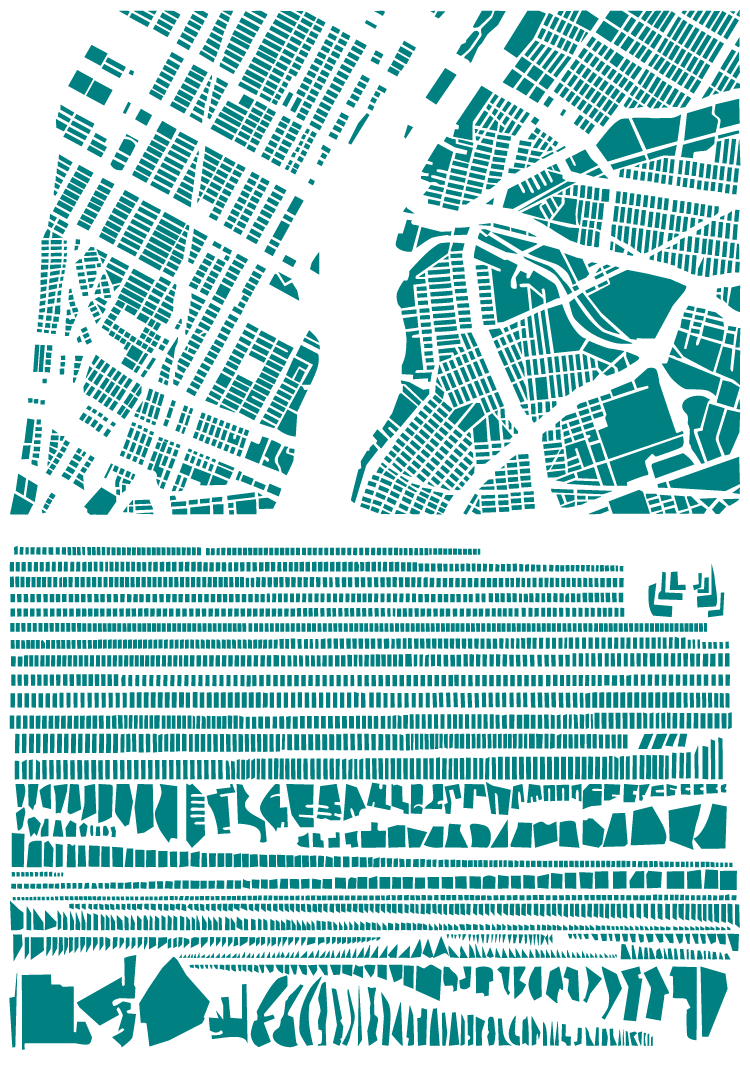
The Star today published a cover story (Beyond Density) in their Condos section on the efforts in Mississauga to create a more vibrant and pedestrian-friendly downtown - key among the problems identified has been the large scale of the block patterns in Mississauga - to prove the point the article includes urban form/fabric drawings of 9 cities (one hopes at the same scales) in order to compare the scales of the fabric of the street network. I include the drawings below alphabetically (with Mississauga first).

(edit: a friend requested I lay out all the drawings in a grid for easier comparison - I hope you enjoy - click on the above image for a larger version) 

More than anything, the comparisons expose the inherent problems of scale in trying to evolve any suburban, auto-oriented area into a more pedestrian-oriented centre. The traditional response in suburbia has been to internalize pedestrian areas (in the form of the mall), Square One (home to the largest Walmart in the world) being a particularly powerful example, though Scarborough Town Centre might be the more classic one. The size of Square One’s block makes a very interesting comparison with Copenhagen’s city centre (3rd below) in which a series of streets and spaces have been linked together and pedestrianized (view a map of the pedestrian areas of Copenhagen from Metropolis magazine). In size or length of pedestrian space, the two might even be close, but in overall character and degree of integration into the urban fabric (particularly important for pedestrians) they are from wholly different worlds and you can easily trace much of these differences to the scale of the street fabric.

The other striking lesson from such comparisons is that there really is no perfect form of street fabric - many different networks and patterns are capable of producing wonderful places and being friendly for pedestrians as long as their fabric allows frequent and comprehensive linkages - there simply seems to be an upper scale beyond which all hope of efficient (and therefore popular) pedestrian circulation is gone.


MISSISSAUGA: “Long blocks and virtually empty sidewalks”

Barcelona Urban Fabric
BARCELONA: “La Ramblas is the main north-south promenade”

Copenhagen Urban Form
COPENHAGEN: “City features a car-free zone called the Stroget”

London Urban Form
LONDON: “The Mayfair and Soho districts south of Oxford St”

New York Urban Form
NEW YORK: “Midtown Manhattan south of Central Park”

Paris Urban Form
PARIS: “Streets were designed by Georges-Eugne Haussmann”

Rome Urban Form
ROME: “East of the Tiber River bend that points to the Vatican”

San Francisco Urban Form
SAN FRANCISCO: “Market St splits the central city into two grids”

Toronto Urban Form
TORONTO: “Between Queen and College Sts east of Bathurst”

Mapping Our Urbanism Part V - Watersheds

080113_watersheds-e_sm.jpg

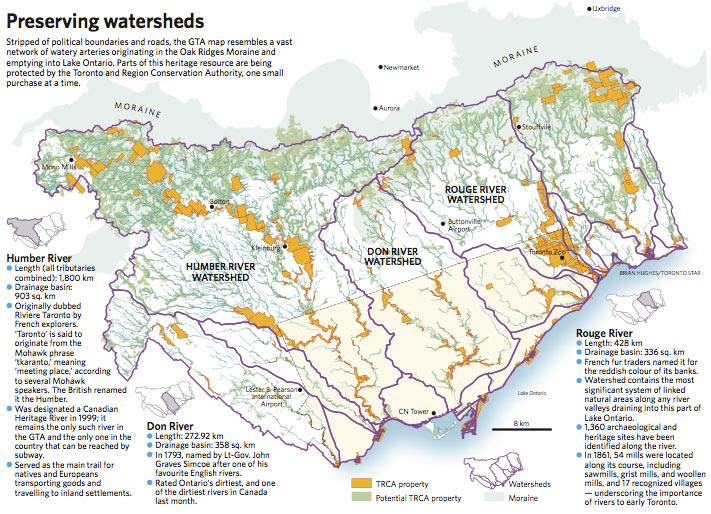
Along with its article today about the TRCA’s work preserving watersheds in the GTA (Clock is ticking for conservation dream), The Star included a beautiful map of the major watersheds flowing south from the Oak Ridges Moraine through Toronto (click on the image for a larger version). The article describes some of the difficulties the TRCA is having in expanding its protection in the upper reaches of many of the watersheds.

The Star poetically continues:

“Stripped of political boundaries and roads, the GTA map resembles a vast network of watery arteries originating in the Oak Ridges Moraine and emptying into Lake Ontario.”

The original PDF (watch out, 9MB) can be downloaded from their site.

Crossposted to spacing toronto as part V of a series - to view the four earlier parts follow these links:

Mapping our urbanism part IV - language

Mapping our urbanism part III - water mains

Mapping our urbanism part II - extents

Mapping our urbanism part I - snow ploughing

Mapping Our Urbanism Part IV - Language

gta-language-quilt_main-e.jpg

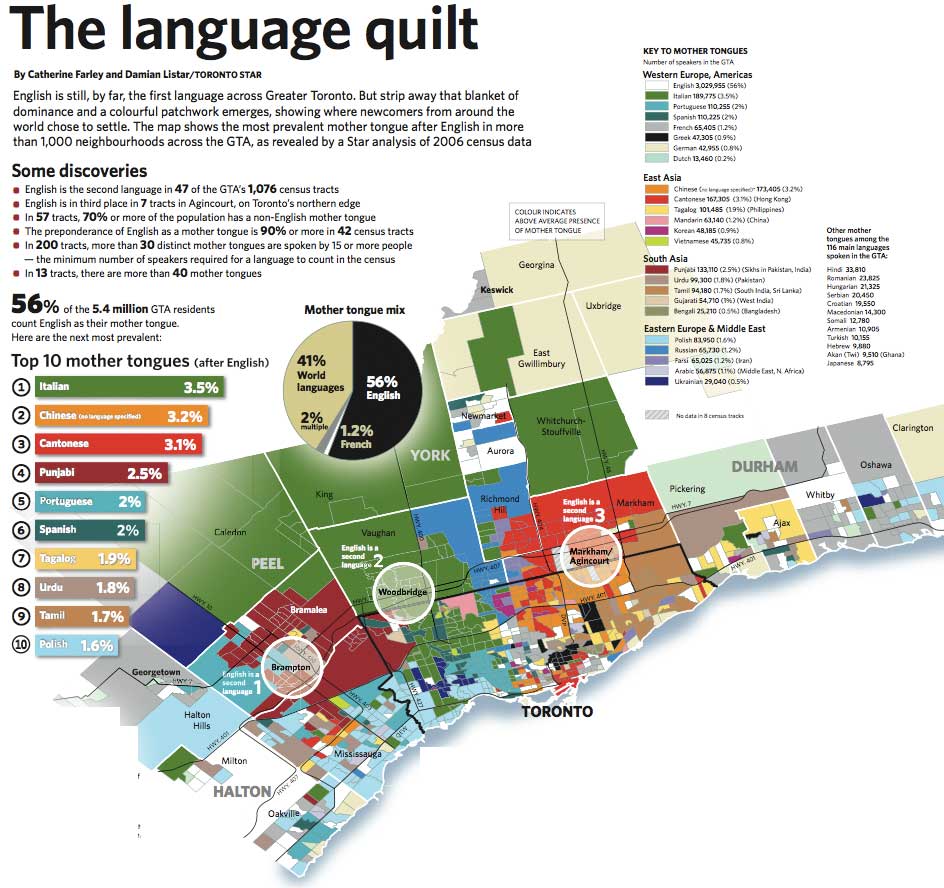
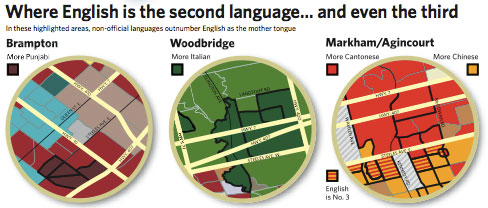
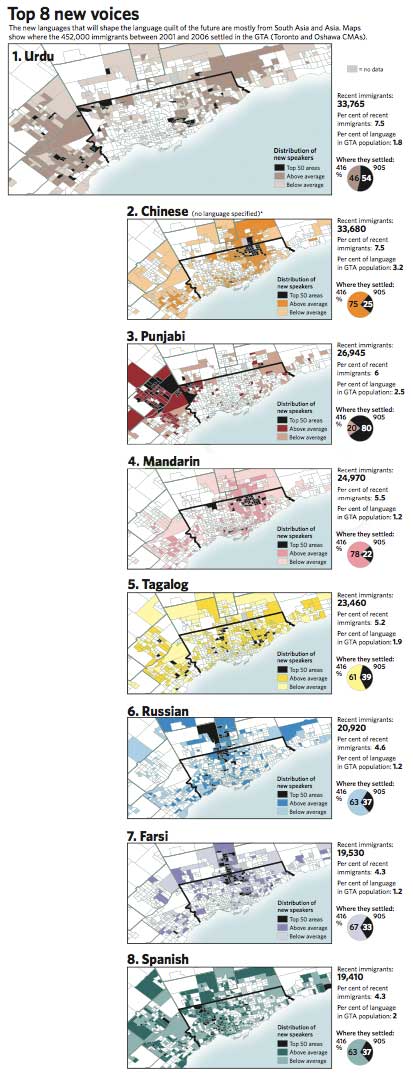
The Star included a map of “Greater Toronto’s language quilt” in their Ideas section today compiled based on recently released 2006 census data. The map is hidden away on their website in a massive (c. 20MB) pdf file (if you dare, here’s the link), so here are some more easily digestible images of the spread’s content (click to enlarge).

While we love to trumpet Toronto’s diversity, it’s nice to have some statistical proof to back up our claims. It’s pretty fascinating that the second largest language group in the GTA (by mother tongue) only represents 3.5% of the population, and yet with only 56% of the GTA reporting English as a mother tongue, the balance of 44% is made up of an incredibly diverse group of languages.

The Star describes their methodology for the creation of the main map (above):

BUILDING THE MAP OF SECOND LANGUAGES
Our challenge was to show the many language communities while retaining the areas where English overwhelmingly dominates:
- Only languages that ranked second in at least 5 census tracts are shown on the map.
- To replace English — the dominant language in 95% of census tracts — the second language must be above its GTA average.
- If languages were tied, the census tract was assigned to the language that was highest compared to its own GTA average, representing a more significant pocket.

gta-language-quilt_eng-2nd-e.jpg

gta-language-quilt_top-new-e.jpg

Crossposted to spacing toronto as part IV of a series - to view the three earlier parts follow these links:

Mapping our urbanism part III - water mains

Mapping our urbanism part II - extents

Mapping our urbanism part I - snow ploughing

A sense of scale, a sense of space, a sense of place?

Construction Hoarding on St. Thomas
Photo: St. Thomas St, Yorkville

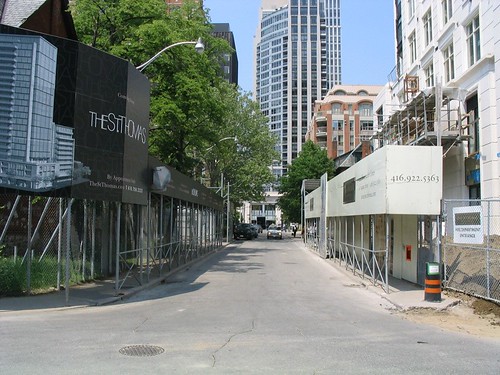
A second construction hoarding was erected on St. Thomas St south of Bloor recently, across the street from an existing hoarding (which has since been taken down). For a short time, the two facing hoardings protecting the sidewalks appeared to resemble a street lined with arcades, in its small spatial scale not unlike many you will see in southeast asia, such as this one in Singapore.
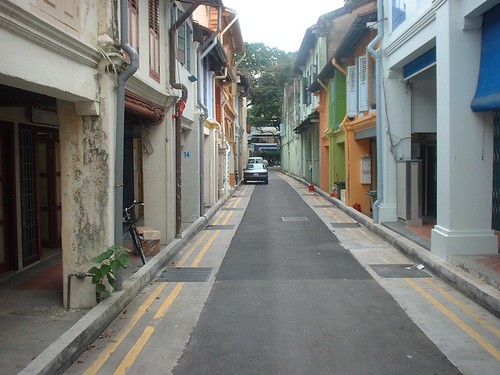
Street with arcades, Singapore
Photo: Street/lane in Singapore

This small scale of space is a relatively infrequent occurrence in Toronto, especially as part of a public street. While we’re used to such small scales in our back alleys, those alleys are, with but few exceptions, the city’s backdoors - infrequently travelled and largely empty, with few uses facing on to them other than the occasional residence and dominated by garages or blank walls and service entries. They do not really form a part of the public face of the city or city life.
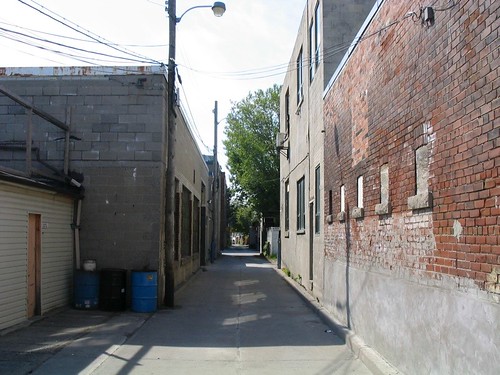

Photo: Laneway in the Junction
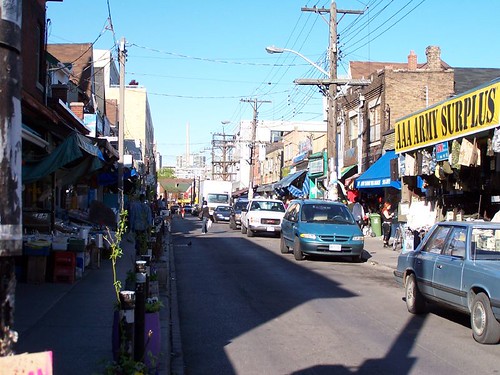

Photo: Kensington Market (photo by raptortheangel)

Somewhere approaching this scale of space that is part of the public face of the city is most famously exemplified by Kensington Market, where not only the buildings, produce and products are jostled up against the sidewalk, but the streets are narrow and bustling with people, and to add to the compression of space, filled with parked cars and delivery trucks and slowly crawling traffic. It all adds up to a very human (dare we say humane?) scale that somehow makes you feel comfortable, as though you’ve been enveloped in the city. In fact, Kensington moves beyond a sense of space, and somehow transcends that rather empty word, to have evolved a sense of place, one that is both undeniable and unique.
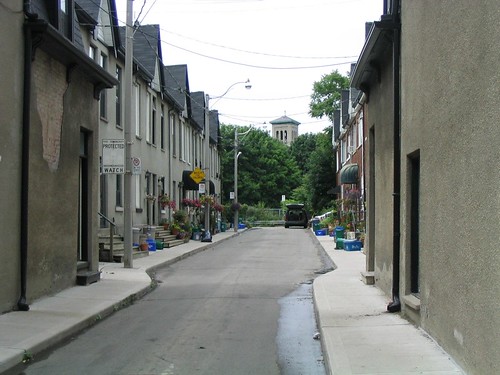

Photo: Wilkins Ave, off King St E, east of Parliament

There are a few other examples of small space in the city, but they tend to be rather hidden and brief moments - although that just makes them seem all the more jewel-like when you discover them.
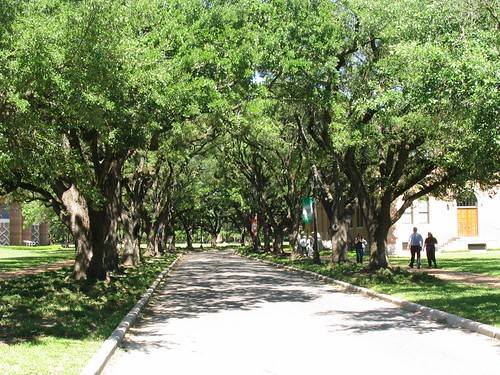

Photo: Tree-lined street at Rice University, Houston

While small space is not the only way to attempt to foster sense of place, I think that there is some connection between this sense of scale, sense of space and sense of place. Similar effects of scale can even be created by the canopies of closely-spaced street trees, as at Rice University (above), but can also be misguided in implementation as in this accident of line-of-sight where Casa Loma’s tower is perfectly framed by the laneway between Walmer Rd and Spadina Rd south of Davenport, which doesn’t so much benefit the laneway itself, but creates some sense of drama and intrigue for all those people walking along MacPherson Ave towards George Brown College.
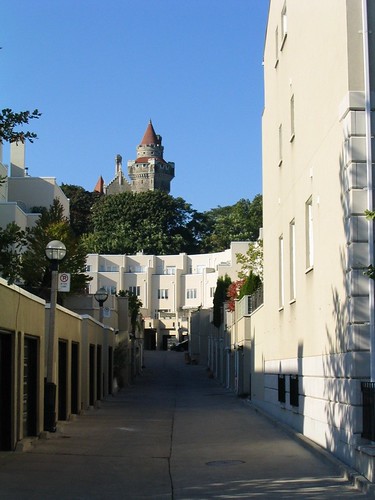

Photo: Looking towards Casa Loma up rear lane between Walmer Rd and Spadina Rd

Whether or not anyone agrees with me about the importance of small scale when it comes to sense of place, I think we can safely say that a key missing ingredient in the urbanities being created in suburban locales around Toronto (and the rest of north america) is the absence of small-scaled space. This absence has been compensated for in many different ways, but most notably (need I say, horrifically and ironically?) by the deliberately pedestrian scale of space of the “shopping street” inside the typical mall and, more recently, by the creation of “pedestrian-oriented” centres in suburban locales, usually surrounded by seas of parking and/or parking garages and huge arterial roads and/or expressways. These new “centres”, sometimes presumed to be the end of the mall (and often replacing them), are in reality the mall’s evolution into a more plausible (but still staged) “reality”, one that is once again based upon the smaller scale that has become nostalgically associated with our cities’ historic centres and main streets.

Whether this small scale can once again be more fully integrated into the urban environments we are building may depend on the level of commitment we as a society are willing to make to creating spaces and places planned and designed around people instead of cars. On this question the jury’s still out. Despite recent progress and a lot of talk to the contrary, the evidence on the ground does not convince.
Mapping Our Urbanism Part III - Water Mains

to_watermains_early2_e.jpg

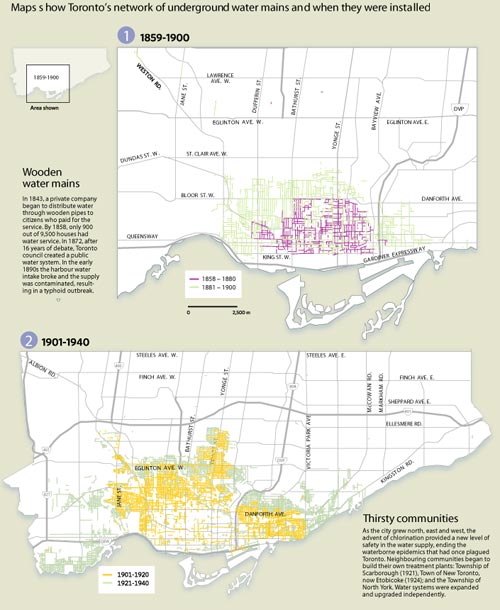
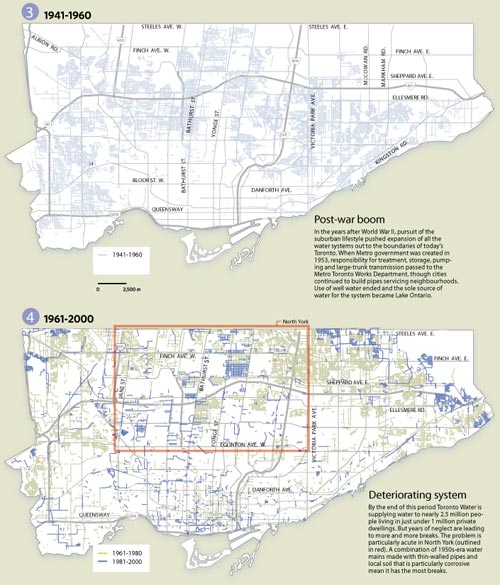
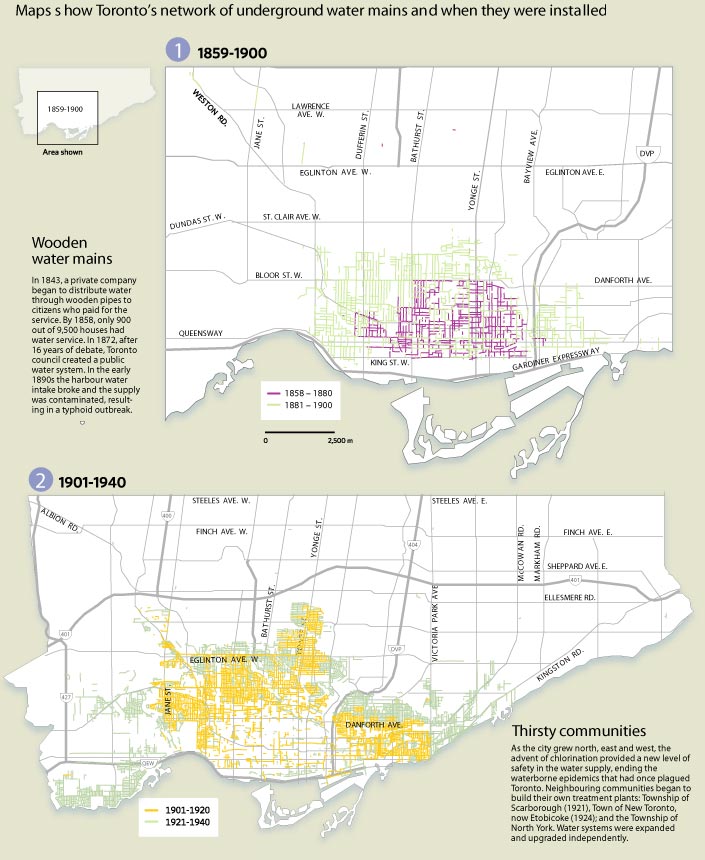
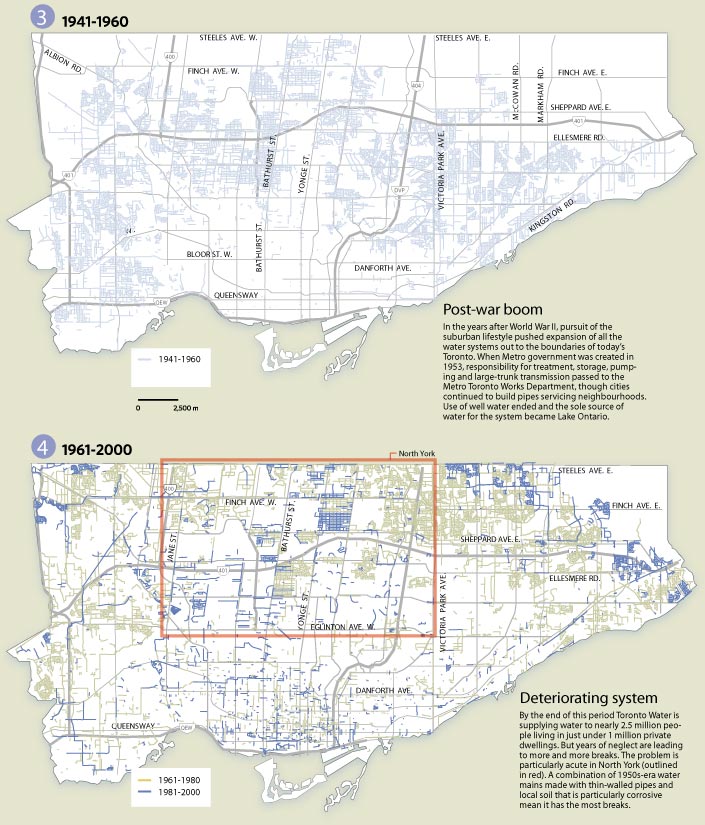
In the Toronto Star last weekend was a special 2-page spread on the sorry state of Toronto’s water mains with emphasis on who’s to pay for upgrades (see story online here). However, the maps included give a fascinating glimpse into the history of Toronto’s development seen through the age of the water mains. Divided into four periods, 1859-1900, 1901-1940, 1941-1960, and 1961-2000, these maps are indispensable for anyone interested in the history of urban infrastructure. To see a little more detail, follow these links (maps 1+2, maps 3+4) - if you prefer a much more detailed PDF version of the maps is available from the Star’s site here (PDF).

to_watermains_modern2_e.jpg

Crossposted to the Spacing Wire 

Mapping Our Urbanism Part II - Extents

ggh-growth-areas_det-e.jpg

The Ontario Government’s revolution of planning in this province continues to move forward. The Places to Grow initiative (Growth Plan for the Greater Golden Horseshoe, see here) has been given a benchmark by a Technical Paper on a Proposed Methodology for Developing a Built Boundary for the Greater Golden Horseshoe, “an important component for monitoring the implementation of the Growth Plan” (see here). Essentially, what has been created is the most uptodate database of the current extents of development in the GGH (and by extension, the GTA). Knowing the current extents of development is crucial to being able to evaluate progress on the stringent intensification requirements demanded by Places to Grow and the implementation of the greenbelt.

What’s great for the purposes of mapping our urbanism is that these maps (excerpted from the new Technical Paper) give us an accurate and uptodate view of the extents of the city and greater region as it is essentially right now, and also how the extents of current development fit into the protected land of the greenbelt. This is quite a unique view of things, and one that is much clearer to read than a satellite photo.

ggh-growth-areas2e.jpg

Mapping Our Urbanism Part I - Snow Ploughing

snow-plow-map_toronto_det-e.jpg

snow-plow-map_toronto_leg-e.jpg

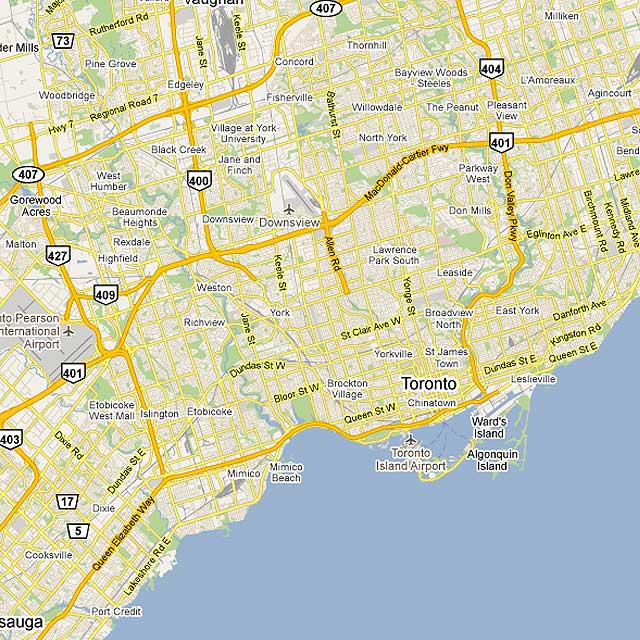
It might seem bizarre, but this map of sidewalk snow plowing service (which I found inside a publication called City Routes put out by Toronto’s Transportation Services available online here) speaks volumes about the different urban forms across the City of Toronto. The zone defined by the inner red line contains “areas where vast majority of sidewalks cannot be ploughed”. The reasons given are that “sidewalk snowploughs are not able to operate effectively due to sidewalk width and a lack of boulevard space for snow storage”. No doubt on-street parking also plays a role, but the policy is also a legacy from the pre-amalgamation City of Toronto which to a large degree fell within the two reddish lines on the map, and which relied on residents and businesses to clear the sidewalk in front of their own premises.

However, using the old boundary of the pre-amalgamation City of Toronto as a means of defining the limits of a particular “urbanism” (shall we call that an amalgam of urban form and urban culture?) is not necessarily accurate, as some of the outlying areas began to be built at lower densities even while sticking to the grid system common throughout the older city (the same can be said of Vancouver, where looking at a map shows the City proper almost entirely gridded, a fact that hides the reality that much of the southern and eastern portions are essentially gridded lower-density suburbs).

So, I propose that this map of sidewalk snow ploughing service is actually a good measure of defining the older, traditional residential core of Toronto, an issue that can raise hackles of nostalgia when defined by other measures. The smaller sidewalks and lack of boulevards is highly suggestive of the more urban character of the residential streets in this zone, in particular, sidewalks being directly adjacent to the roadways and in most cases, on-street parking. This zone is also the one with the best pedestrian and transit connectivity. I haven’t checked, but I think you will also find that almost the entirety of the defined area was developed before about 1930 and much of it before the First World War, primarily as streetcar suburbs.

The street names are hard to read so I’ll describe the boundaries - the west boundary is Jane Street - Bloor West Village is one of the last neighbourhoods to stick to the older street tradition. To the north (west of Yonge) the boundary floats north of St. Clair, including many of the neighbourhoods a walking distance from St. Clair. To the east of Yonge, the north boundary swings down close to the Danforth, then runs east to about Victoria Park to include the eastern neighbourhoods of the old City. Of course, this line closely follows the pre-amalgamation boundary of the City of Toronto in many ways, with the northern “stub” removed, but in some ways this map bypasses the hard feelings associated with the whole amalgamation extravaganza to get right down to a question of urban form and lifestyle.

Here’s the full map to show the zone in context:

snow-plow-map_toronto-sm2e.jpg