urbanism – landscape – ideas – theory – whimsy

Toronto Transit Map Reimagined
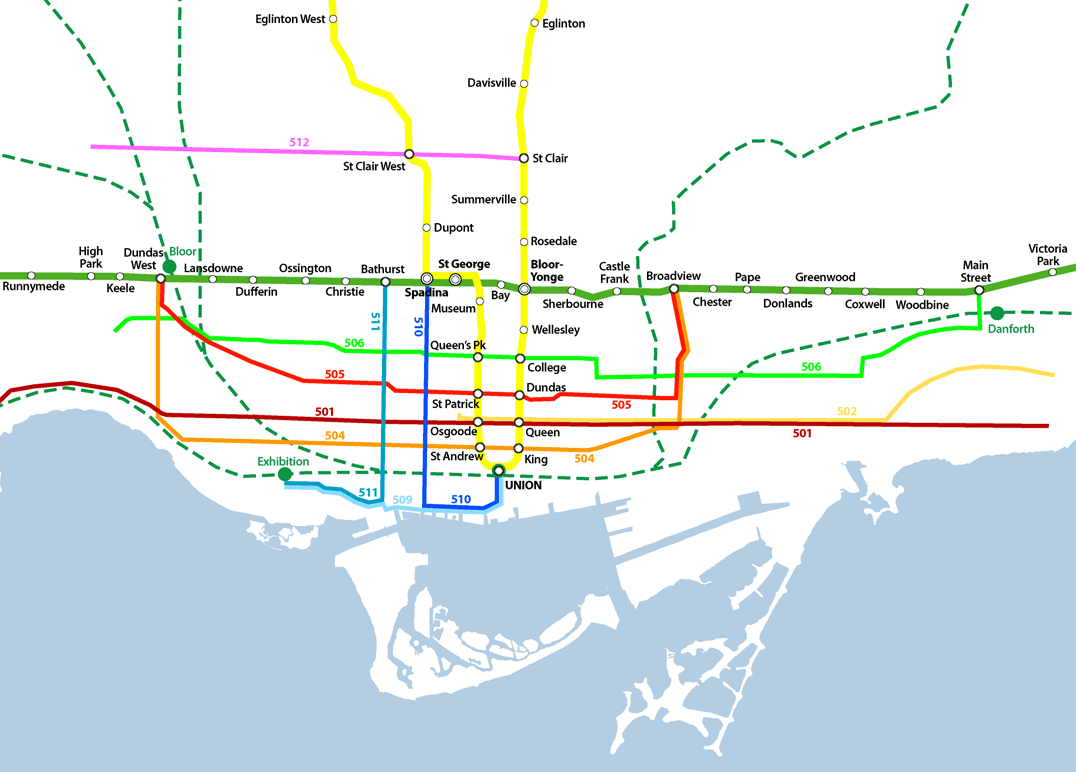
ttc-map-rc3_crop_detail-e-sm2.png

Somewhere someone was asking for someone to come up with a reimagined transit map for Toronto (could it have been Reading Toronto here?), so I thought I’d give it a shot. The one Graeme Stewart posted at Reading Toronto is interesting but I find it too schematic-looking. At the GTA level, scale is grossly distorted, but on the downtown detail map I love how he managed to integrate neighbourhood names into the map. Fantastic.

Part of his point was that more of the system should be shown than just the subway – the GO lines and the streetcars should be shown to represent more of the true nature of the “system” and I think I support his idea. However there are certain caveats and problems:

  1. Apart from supposed “dedicated right-of-way” LRT streetcar lines (such as Spadina’s 510 line and the Queen’s Quay lines and the western portion of the Queen 501 route along the Queensway), streetcar lines in Toronto are having serious problems moving swiftly through the city. One hears complaints of people being able to walk faster than the Queen cars move through traffic. Even the dedicated right-of-way lines have issues – a report I read indicated that the Spadina car on average is slower at getting its passengers down to Queen than the old pre-1997 buses were – I also have friends who live out near Mimico for whom in most cases taking the subway and getting a bus is quicker than the 501 car. This does beg the question of whether they should be included when some frequent service time-efficient bus routes are not.
  2. On Stewart’s GTA map (here), GO Transit’s rail network is given heavy prominence next to the subway lines. Indeed on GO’s own system map, their train network is given heavy coloured-line subway-like prominence, with the bus network as more generic thinner green lines. I flirted with this idea, but for now have settled for a more toned-back approach to the GO network for the simple reason that until higher frequencies are achieved and more serious urban centre-type development occurs around GO stations, the system currently bears little resemblance (in reality) to an LRT, BRT (Bus Rapid Transit), or subway system since it is heavily skewed towards commuter traffic alone.
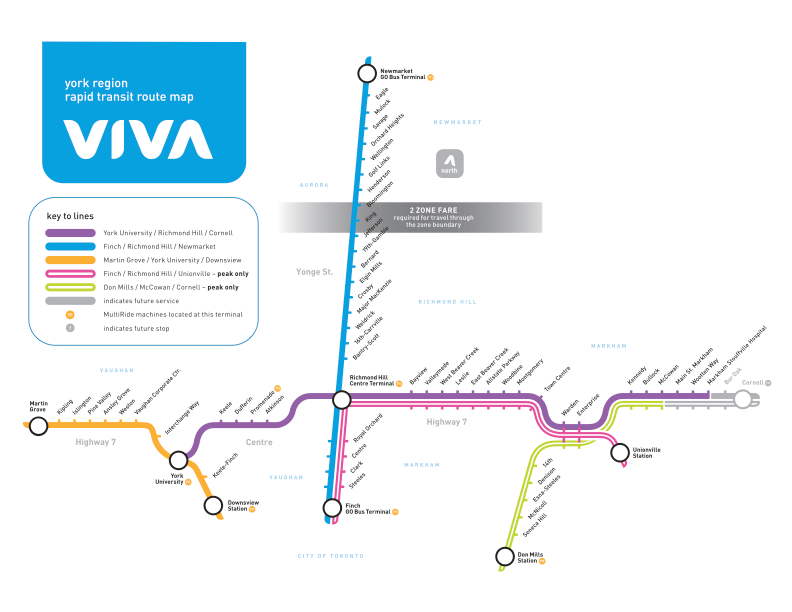
  3. VIVA is here – York Region’s BRT transit offering is up-and-running (for a year now), and should be given heavier priority at the regional scale. I dream of a day when an integrated fare-structure allows simple and straightforward use of all these systems together with full transfer privileges and no complications – perhaps trying to envision what the system even looks like as a whole is the first step? For now I have only shown full-service routes of VIVA, not peak-only. I don’t actually even know whether any of the other GTA municipalities have BRT-equivalent frequent-service routes to add – if they have, I haven’t heard of them.

I am also working on a full GTA level map showing all GO lines to their ends. All of these maps are real-scale without distortions in space – the disadvantages are that at smaller sizes, things become harder to read and distinguish. It could be that after I’ve done these, then a simpler diagram version could be done that distorted distance as most existing transit maps do.

Style – I’ve tried to stick to the current TTC diagram style. Why? I kind of like it. I am from Toronto though. Others, such as Miguel Syyap’s quite wonderful TTC maps, have used London Underground’s famous style – which I must say looks good too! For some reason Syyap hasn’t shown an as-is system map using his style though. VIVA has adopted this same style for their diagrammatic system maps.

Here’s links to higher resolution versions of my map:

Toronto Transit Map – downtown detail

Toronto Transit Map – Metro +

Let me know what you think – any suggestions?
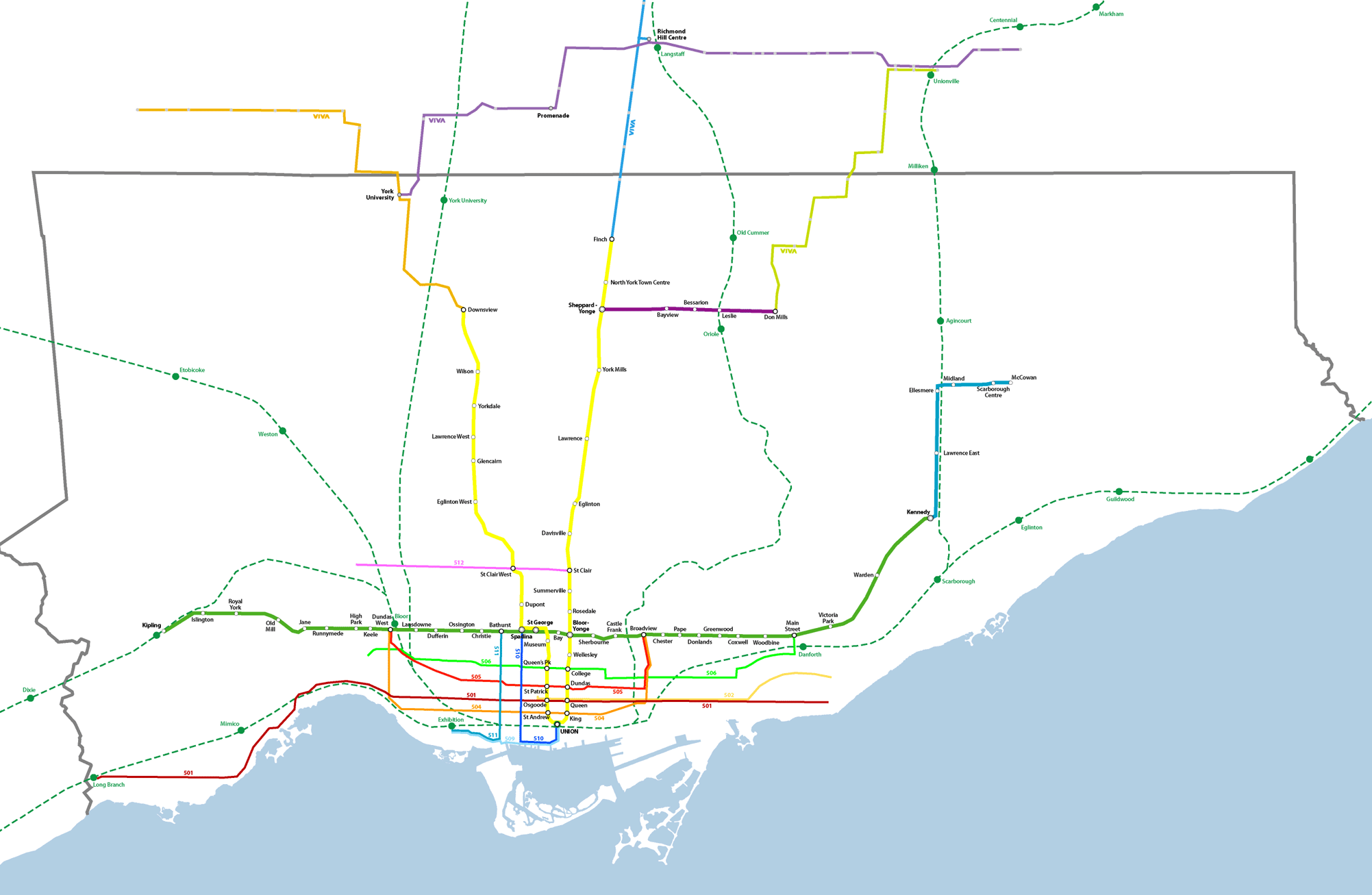
ttc-map-rc3_crop-e-sm.png

Also see our evolution of the TTC subway animated map from September 2007.
Development in Toronto Part VI – Gateism

282_8244_e.JPG

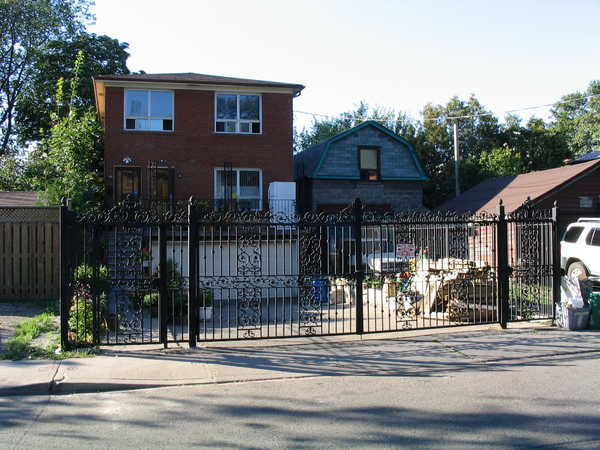
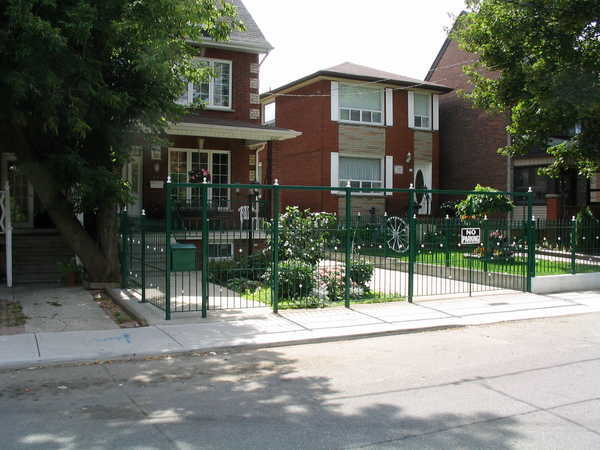
I’ve been noticing an increase in “gateism” along the residential streets of Toronto. While they say that “good fences make good neighbours”, there’s something about fences that are higher and more robust than seems necessary that leads to a few worries. Fences alone are one thing – they do a great job of defining space and ownership and are an easy way to quickly read the definition between public and private urban space – while without gates they can also be penetrated with ease. Gates on the other hand, are more worrying. The gate doesn’t rely on subtle hints to define public and private, but demands compliance through a physical barrier. Usually, one would assume a gate is either intended to keep something in or keep something out. If these gates and fences are being erected to keep dogs in I would be very surprised. If they are in response to some perception of a threat from the general public, it suggests a worrying trend for this city’s public space.

In countries such as England, gateism as a response to perceived security threats from public space have led to broken glass and barbed wire on the tops of walls, and no side passage left ungated. Increasing numbers of houses in Toronto seem to be gating their side alleys in a city where there used to be a relative permeability between front yard and back. On the other hand, increasing densities and busier street and foot traffic demand responses to maintain the privacy, security and serenity of the urban home. This current form of gateism does not seem to be desirable, but it’s obvious that people are expressing a desire for more privacy than the typical form of the city and its open front yards is supplying. The city should be encouraging more creative and beautiful solutions that rely less on the aesthetic of the security perimeter and more on an integrated landscape strategy. In the meantime, we will probably have to get used to a streetscape defined less by semi-private overlooking porches, and more by visually impermeable fences, hedges and gates.

282_8233_e.JPG

Is the Wind Economy Here?

284_8403_e.JPG

Toronto’s Windshare wind turbine may have gotten people excited, but its small output and difficulties in negotiating further urban turbines in Toronto make the project little more than a (much-needed) publicity excercise for clean power. The Windshare turbine is 0.75MW, capable of supplying the power needs of about 250 average homes. The real action is in wind farms in areas with steady wind characteristics, one of the most promising of which (in Ontario) is the eastern shore of Lake Huron.

The above photo is of the Kingsbridge I wind farm north of Goderich near the shore of Lake Huron. The project consists of 22 wind turbines and is rated at 40MW, capable of generating enough energy for 12,000 homes. Phase 2 (Kingsbridge II) will have 70 windturbines for 160 MW, giving a total of 200 MW for phases 1 and 2. The province of Ontario is helping fund renewable energy projects through a procurement process with the goal of having 10% of Ontario’s power generated from renewable sources by 2010. Allowing wind farms to be built on Crown land is one of their key initiatives. See the Ministry of Energy’s site for a map and list of new projects. The government of Canada meanwhile has had a Wind Power Production Initiative since 2001 using incentives to cover the costs of half of the premium for wind power for the first 10 years of a given project (see WPPI info here).

Ontario also has a commitment to eliminate all coal-fired energy generation by 2009, but in June Premier McGuinty backtracked on this promise specifically with regard to the Nanticoke plant on Lake Erie which is “the largest coal-fired power plant in North America and Canada’s #1 air polluter.” In 2005 Nanticoke produced as much air pollution as 3.3 million cars according to the Ontario Clean Air Alliance. The OCAA is advocating converting the plants boilers to natural gas for the rest of its operation, a conversion that would not be particularly costly.

The relevance of all this to urbanism in general may be self-evident but I feel like I should spell it out. The removal of key renewable energy production to less visible locations outside of the city may have less of of a direct impact on public perception of progress in renewable energy sources, but we can’t ignore the effectiveness of locating wind farms in places where there is the best wind and where a large number of turbines can be concentrated. Despite this, as primary energy users, urban dwellers musn’t allow themselves to lose sight of the importance of the origins of our electricity.  While most of the cities in Canada no longer have influence on the federal government’s energy policy, it is our duty to continue promoting energy conservation and increased renewable energy sourcing to help meet the Kyoto commitments we made as a nation, with much of the nation’s willing support.  It is also our duty to ensure that energy policy remains a key election issue at the provincial and federal levels.  We must do this not only out of self-interest (our urban air will be cleaner as a result), but to do our part in reducing greenhouse gas emissions for which we are all responsible.  Although Canada may stand to get off fairly easy with the predicted patterns for global warming, it would be historically criminal of us to ignore our own emissions to the greater peril of the rest of humanity and the world’s natural systems under the misapprehension that some warmer weather wouldn’t be such a bad thing.